

FUKUSHIMA NEWS
~ ~ ~ ~ ~ ~ ~
Help the
NO NUKES Y'ALL
campaign
y'all
Nuclear Watch South is a 501(c)(3) tax-deductible charitable organization.
{ thanks }
PayPal
It's your
safe and secure
way to donate on-line
 |
~ ~ ~ ~ ~ ~ ~

~ ~ ~ ~ ~ ~ ~
~ ~ ~ ~ ~ ~ ~

~ ~ ~ ~ ~ ~ ~
NEW NUKES for Georgia???

NO THANKS!!!
CLICK HERE
~ ~ ~ ~ ~ ~ ~

CLICK HERE FOR THE
WHOLE UGLY STORY
~
Follow the action at
NUCLEARBAILOUT.org
Educating and activating the grassroots to create a
nuclear-free future
~
PO Box 8574
Atlanta, GA 31106
404-378-4263
Cell 404-432-8727
info@nonukesyall.org
NO NUKES Y'ALL!
GEORGIA | VOGTLE 3 & 4
Georgia Groups Call for Investigation into GA PSC Rubber Stamping of Vogtle Rate Increases
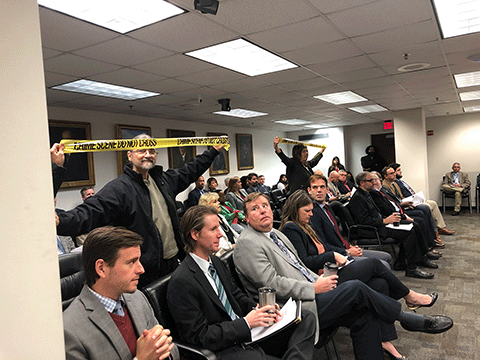 Georgia Power customers express their outrage at the Georgia PSC's unanimous vote to pass $7.56 billion in Vogtle cost overruns onto Georgia electric customers by displaying CRIME SCENE tape immediately following the 12/19/23 vote. Georgia Power made $17 billion in profits during Vogtle construction years. Photo ©2023 Bets Rivard
Same Story, Different State: 26% Electric Rate Increase OK’d by Georgia PSC Follows Similar Corruption Schemes
in Ohio, Illinois, and South Carolina
ATLANTA 12/21/23: The Georgia Public Service Commission (PSC) and Georgia Power are facing renewed accusations of collusion and possible corruption following the recent rate increase approved by the PSC for the Vogtle units 3 and 4 nuclear expansion project. Similar to recent high-profile nuclear corruption scandals in Ohio, Illinois and South Carolina, Georgia’s utility commissioners acted against the best interests of Georgia ratepayers, rubber-stamping cost recovery for mistakes made by Georgia Power.
Georgia Power, despite numerous warnings and opportunities to avert rate increases, secured rate base increases of $7.56 billion in cost overruns for Vogtle 3 and 4 during the Tuesday hearing before the Georgia PSC. This rate increase, added to previous rate increases for Vogtle, will raise residential and small business electric rates by 26%. The full rate increase adopted by the PSC will go into effect when Vogtle 4 attains commercial operation. The Tuesday PSC vote for $7.56 billion only included construction costs. Once Unit 4 enters commercial operation, Georgia Power will expand their rate base an astounding $11.1 billion to include financing costs of $3.5 billion, on which Georgia Power also profits.
Nuclear Watch South and Georgia WAND believe the SEC should investigate Georgia Public Service Commission and Georgia Power as it did for the failed Summer nuclear expansion in South Carolina and the recent bribery scandals in Ohio and Illinois. In October a Southern Company whistleblower brought the SEC to bear on the failed Kemper carbon capture coal plant being built by Southern Company's Mississippi Power. Southern Company is also the parent of Georgia Power.
Glenn Carroll, Nuclear Watch South's coordinator on Tuesday, said, “The Commission's decision to saddle Georgia Power ratepayers with an additional $7.56 billion in costs for Vogtle Units 3 and 4 demonstrates the complete lack of meaningful regulatory oversight to protect consumer interests. From the very beginning, the PSC and Georgia Power have turned a blind eye to the construction problems and delays that have plagued this unneeded project. This level of contempt for hard working Georgians, who pay their electric bills under the assumption that they aren’t getting ripped off, is shameful and deserving of a federal investigation - similar to the investigation in Ohio that found its top utilities regulator accepting bribes from the utilities he was supposed to regulate.”
Earlier in December, former Ohio Public Utilities’ Commission (PUCO) chairman Samuel Randazzo was charged by federal prosecutors for bribery and embezzlement crimes related to the 2020 bailout (HB 6) of nuclear power plants in Ohio. Similar to the Vogtle expansion, the Ohio PUCO rubberstamped cost increases for ratepayers for (in this case existing) FirstEnergy-owned nuclear reactors, against the interests of Ohio ratepayers. Randazzo’s arrest followed the conviction of Ohio’s former statehouse speaker, Larry Householder, who was found guilty in the same corruption scheme laid forth by FirstEnergy.
Kimberly Scott, executive director of Georgia WAND, said: “This is another unconscionable financial hit to Georgia Power customers who have been consistently burdened with rate increases from a utility that realized $17 billion in profits during the span of Vogtle construction when construction costs were underestimated and behind schedule. Georgia Power executives admitted to mistakes in the planning and execution of the new reactors, but have refused to shoulder the financial burden of these mistakes, and instead have passed the increased costs off on to customers, with the approval of PSC Commissioners. This enormous rate hike is based on a stipulated agreement between PSC staff and Georgia Power which was struck before any public hearings or presentation of any evidence.
“There is an extensive history of corruption in the nuclear industry, most recently in Ohio where former house speaker Larry Householder was sentenced this year to 20 years in prison for racketeering related to a nuclear plant bailout. Illinois and South Carolina’s nuclear scandals resulted in numerous federal convictions. Nuclear power plants deliver enormous profits to utilities since state authorities almost always force customers to pay huge rate increases for the inevitable cost overruns. That is what happened to us in Georgia – and now it’s time for a full accounting of what happened behind closed doors.”
Patty Durand, former president of the Smart Energy Consumer Collaborative and a recent candidate for the Georgia PSC, spoke as an expert witness on behalf of the Concerned Ratepayers of Georgia in the recent Plant Vogtle prudency proceeding before the Georgia PSC. She wrote in a letter to the Atlanta Journal Constitution following the Georgia PSC’s approval of the rate increase: “The Georgia Public Service Commission allows Georgia Power to receive rich profits – far higher than industry norms, which violates their mandate of regulating in the public interest. And elected commissioners voted on Tuesday to make it worse by approving the largest rate increase in state history for Plant Vogtle, the most expensive power plant ever built on earth.
“Commissioners have known for years that the cost of construction for nuclear energy was far higher than other forms of generation, yet authorized this project with no cost cap or customer protections. As predicted, Vogtle construction costs went far over budget, yet commissioners do nothing to help vulnerable populations afford utility bills. Even before these huge cost increases take effect, over 240,000 Georgia Power customers were disconnected from power last year, with most of those disconnected belonging to minority households.
“The people of Georgia deserve a state agency that protects them from monopoly overreach instead of celebrating how business friendly they are, but that's not what we have. Meanwhile, Public Service Commission elections have been on hold for over a year due to litigation related to violations of the Voting Rights Act, and two commissioners in expired seats continue to vote.”
DOWNLOAD PRESS RELEASE
GRAND THEFT NUCLEAR
Public Service Commissioners Display Disregard for Georgia Power's Captive Customers in Hurry-Up Final Hearing on $7.56 Billion in Vogtle Cost Overruns
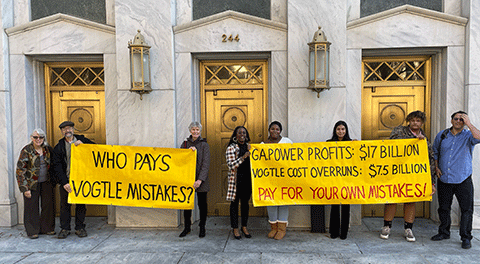 Georgia Power customers attended the final public hearings on Vogtle 3 & 4 cost overruns on December 4, 2023, at Georgia Public Service Commission. Sumter County high school students Joy, Brandy, and Brendan joined activists from Georgia WAND, Nuclear Watch South and Georgia Conservation Voters in front of the 244 Washington Street entrance to the Paul Coverdell Legislative Building. Photo by Glenn Carroll
ATLANTA 12/5/23: Several public witnesses trekked to the Georgia Public Service Commission to speak truth to power in the final Vogtle public hearing which has all the hallmarks of being a fixed game.
Nuclear Watch South and Georgia WAND have participated in Vogtle proceedings at the PSC since the project was first certified in 2009. The groups were astounded when the Public Interest Advocacy arm of the PSC filed a negotiated stipulation simultaneously with Georgia Power's request for $7.56 billion in cost overruns in which they agreed to Georgia Power's request. Even more shocking, public interest groups Georgia Watch and Southern Environmental Law Center (SECL) representing Georgia Interfaith Power and Light (GIPL) and Partnerships for Southern Equity (PSE) signed the agreement as well.
Nuclear Watch South and Georgia WAND followed upon their Petition to Hold in Abeyance with an Open Letter to heads of the PSC and Georgia Power which the groups subsequently published in full-page newspaper ads around the State of Georgia listing more than two dozen groups and 200 individual signers who endorsed our letter.
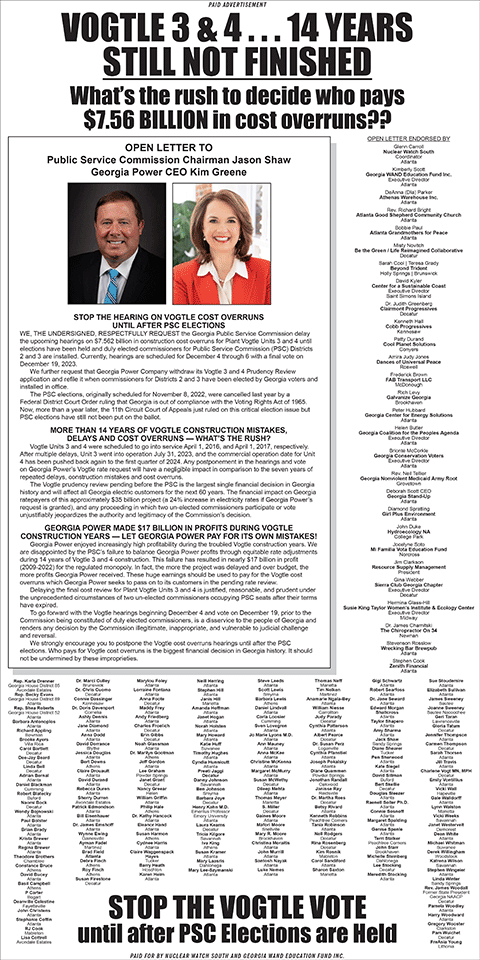
CLICK TO DOWNLOAD FULL-SIZE PDF
The hearings began on December 4 with Commission Chairman Jason Shaw rejecting Nuclear Watch South and Georgia WAND's petition.
The commissioners then proceeded to attempt to neutralize public witness comments by inviting ringers such as a vice president of a national nuclear energy lobbying organization and leadership of the International Brotherhood of Electrical Workers. You know, the ones who installed 600 electrical cables incorrectly causing a year and a half delay. Not that it was their fault, since they were victims of Georgia Power's lack of project management. Several commissioners used the opportunity the created to testify themselves, gushing about the prospects of Vogtle 5 and 6 and offering attractive University of Georgia co-eds an internship. A school teacher from Sumter County praised the Vogtle project, Georgia Power and the PSC. She had brought three students with her and predicted they would have a future in the nuclear industry.
The students, however, were not fooled and followed us outside to stand with us and our banners!
The press was not fooled either and quoted several of the genuine public witnesses who came out. Here are links to some of the good stories. All of these stories are syndicated and are appearing all over the state of Georgia and the U.S.
PLANT VOGTLE DEBATE SPLITS ENVIRONMENTAL, CONSUMER ADVOCATES
by Dave Williams | Dec 8, 2023 | Capitol Beat News Service
GEORGIA POWER AGAIN PRESSES CASE FOR CUSTOMER RATE HIKE TO PAY FOR BLOATED PLANT VOGTLE EXPANSION
by Stanley Dunlap | Dec 5, 2023 | Georgia Recorder
REGULATORS BEGIN HEARINGS ON HOW MUCH CUSTOMERS SHOULD PAY FOR GEORGIA NUCLEAR REACTORS
by Associated Press | Dec 4, 2023 | U.S. News and World Report
Patty Durand is running against Tim Echols for PSC. Her campaign has been in limbo since elections were cancelled last November. The day after Thanksgiving, the 11th Circuit Court of Appeals ruled that it was okay with them for statewide elections to be held for district seats, but no elections have been set.
Ms. Durand served as expert witness for longtime Vogtle intervenor Concerned Ratepayers of Georgia. Hers was the lone voice speaking from the expert witness stand as an advocate for Georgia's electric customers. Her excellent testimony can be heard on YouTube.
PATTY DURAND TESTIMONY VOGTLE PRUDENCY HEARING 12/5/23
We are proud to have stayed in the game, which by all appearances is fixed, to the bitter end. We are proud to have changed the narrative to include the fact of Georgia Power's $17 billion in profit during Vogtle construction. (The full-page ad in the Atlanta Journal Constitution which cost $10,625 was also subjected to an approval process.) We are proud to have helped amplify the voice of the public despite the many techniques which were employed to silence us.
On Tuesday, December 19, 2023, the PSC will vote on Georgia Power's $7.56 billion request for Vogtle cost overruns. We hope to see you there for one final stand for truth and justice on the Vogtle boondoggle.
Nuclear Watch South and Georgia WAND
Confront PSC with Petition to Delay Hearing on Vogtle Cost Overruns
 Georgia Public Service Commission (l-r) Tricia Pridemore, Fitz Johnson, Jason Shaw, Lauren "Bubba" McDonald, Tim Echols. Johnson's and Echols' terms expired on December 31, 2023. The un-elected commissioners are still being paid and voting on rate increases nearly one year after the election should have been held.
PSC Faces the Largest Rate Increase in Georgia History while Two Commissioners' Terms Expired in 2022
Atlanta, GA 11/2/23: Over legitimate concerns that two Public Service Commissioners' terms expired December 31, 2022, statewide Georgia nonprofits Nuclear Watch South and Georgia WAND filed a Petition to Hold in Abeyance with the Public Service Commission (PSC) on October 27, 2023. The Petition to Hold in Abeyance asks the PSC to delay hearings on Georgia Power's request to recover $7.56 billion in mistakes, delays and cost overruns for Vogtle construction. If approved, it would be the largest rate increase in Georgia history, and petitioners request the PSC to hold the hearings in abeyance until after all five seats on the commission are held by duly elected commissioners.
Currently, the PSC has hearings on the prudency of Vogtle cost overruns scheduled for December 4-6 with a final vote scheduled for December 19.
The petition is needed because an August 2022 federal ruling cancelled PSC elections after finding that statewide voting dilutes the Black vote. Federal Judge Steven D. Grimberg ordered Georgia to discontinue the practice of holding statewide elections for district seats. The State of Georgia appealed the ruling and the elections for Commissioners to represent districts 2 and 3 have been delayed for over a year.
Kimberly Scott, Executive Director of Georgia WAND observes, "It is unprecedented for a federal court to delay state elections while another federal court fails to rule on the state’s appeal which was heard on December 14, 2022. Elections are time sensitive, and this delay introduces new harms to the people of Georgia facing enormous rate increases to pay for the most expensive power plant ever built on earth."
Nuclear Watch South and Georgia WAND argue in their petition that the decision facing the current commission is of unprecedented financial magnitude and to proceed with un-elected commissioners potentially jeopardizes the authority and legitimacy of any decision that body may make.
Glenn Carroll, Coordinator of Nuclear Watch South, addressed the PSC at the November 2 Energy Committee meeting on behalf of her group and Georgia WAND. In her comments she said, "Nuclear Watch South and Georgia WAND's Petition to Hold in Abeyance is reasonable and prudent in light of these unprecedented circumstances now surrounding the largest construction project in U.S. history. The failure to elect District 2 and 3 commissioners coupled with Georgia Power submitting its request for the highest rate increase ever creates a perfect storm which puts this commission and the citizens of Georgia, whom you serve, at great risk."
©2023 11 Alive News Atlanta
Chairman Jason Shaw told Nuclear Watch South and Georgia WAND that the Petition to Hold in Abeyance is under review and they are allowing 30 days for interested parties to respond. PSC Spokesman Tom Krause was quoted in Mary Landers' story for WABE saying, “Typically, when we get motions like that from outside parties, we give them 30 days, so that other interested parties can make any filings or comments that they want to. And just per PSC rules, the chair is allowed to rule on motions like this or can hold a hearing at his or her discretion.”
The two un-elected commissioners are Fitz Johnson and Tim Echols. Fitz Johnson's case is especially singular as he was appointed to complete the unfinished term of Chuck Eaton and that appointment ended December 31, 2022. The petitioners are unaware of any precedent or authority in which an un-elected appointee may continue to serve after expiration of the appointed term.
In the interest of fairness and for the reasons specified, the PSC must delay the hearing to adjust rates to include Vogtle 3 and 4 and allow voters and Georgia Power customers time to elect new commissioners. Only then should the request and the vote for a rate increase be put before all five seats held by duly elected commissioners. Georgians living in Districts 2 and 3 are unrepresented by the current Commission.
Ms. Scott says, “The decision to approve the largest rate increase in Georgia history to pay for a nuclear plant that is both seven years late and not even finished makes no sense. Voters deserve the right to elect who represents them in a decision that will last 60 years. What is the rush?”
DOWNLOAD PETITION TO HOLD IN ABEYANCE
NUCLEAR WATCH SOUTH AND GEORGIA WAND COMMENTS TO PSC 11/2/23
AJC: Groups want Vogtle cost hearings halted until
Georgia PSC elections are held
by Drew Kann, 11/2/23
WABE: Court decision expected soon on
Georgia Public Service Commission election
Mary Landers, 11/2/23
Delayed elections could impact your Georgia Power bill | Here's why
11 Alive News, 11/3/23
SNAP! CRACKLE! POP!
Vogtle Lurches Towards Babylon
Georgia Citizens Brace for $35 Billion Vogtle Price Tag
as Georgia Power Amasses Billion$ in Record Profit
GEORGIA 5/30/2023: Nuclear Watch South marks the occasion of reactor Vogtle 3 reaching its 100% power milestone with the release of Georgia Power's latest performance data.
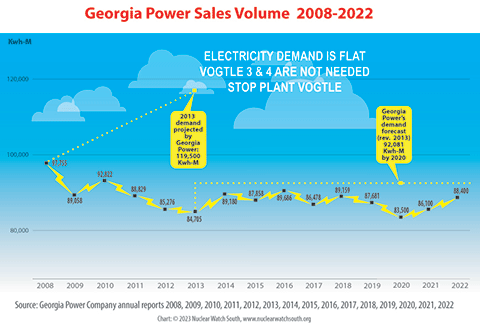
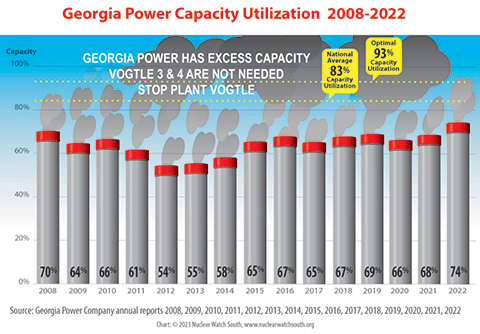
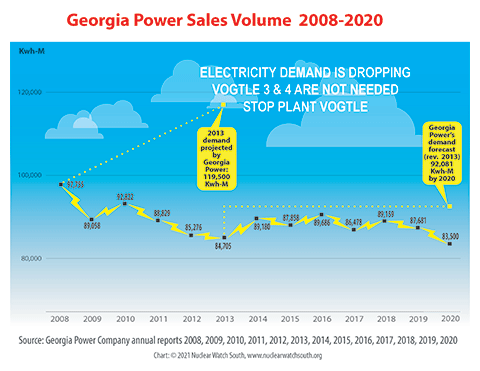
VOGTLE IS NOT NEEDED For 10 years, Georgia Power's performance data as published in their SEC-filed annual reports have consistently shown that the prospective power from Vogtle 3 and 4 is not needed. Projected electricity demand, Georgia Power's sales, widely missed the 4.1% annual growth predicted at Vogtle certification and has shown a puny .36% average annual increase over the past 10 years. Georgia Power's capacity utilization reveals it is not using 26% of its existing portfolio. Vogtle 3 and 4, with a looming price tag of $35 billion, will add 7.4% to this excess unneeded power.
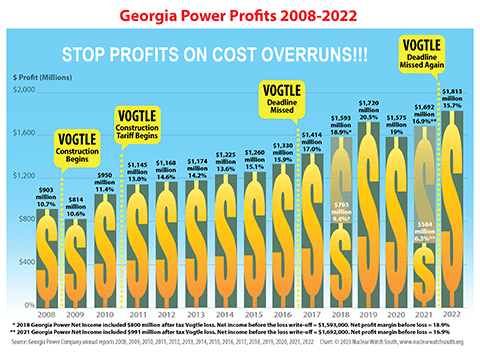
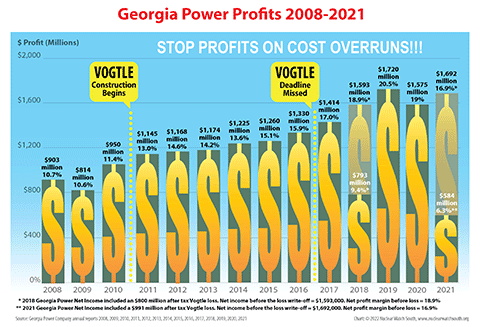
GEORGIA POWER PROFITS SHOULD PAY FOR VOGTLE COST OVERRUNS AND CONSTRUCTION MISTAKES Georgia Power customers are bracing themselves for ever higher electric bills having already paid close to $1,000 on average for Plant Vogtle through the CWIP tariff. Georgia Power, meanwhile, enabled by the Georgia Public Service Commission, has openly amassed over $14 billion in profit during the infamously bungled 12-year Vogtle construction period. Georgia Power should pay for their cost overruns, delays and construction mistakes on Vogtle 3 & 4.
Georgia Power's data is compiled and analyzed for Nuclear Watch South by economist Steven Prenovitz. It is important to note that Georgia Power has never refuted or disputed the data which Nuclear Watch South has been tracking and submitting into the PSC docket on Vogtle 3 & 4 since 2012.
The glacially slow run-up to Vogtle's coming on line has been checkered by equipment failures and regulatory violations. As Vogtle 3 began to power up, a vibrating pipe was discovered. A support strut called for in construction plans was missing. The reactor's run up to 100% power was put on hold for two weeks earlier this month because of failures in the emergency cooling water system. Georgia Power challenged the spirit and the letter of the Nuclear Regulatory Commission's newly adopted safety review by completing tens of thousands of work inspection reports years after the fact.
"An unneeded nuclear reactor is just a radioactive waste factory," says Nuclear Watch South Coordinator Glenn Carroll, "and who needs that?? Georgia Power and the Georgia Public Service Commission have squandered more than a decade and billions of the public's money which could have been used to deploy rooftop solar for all the customers that Vogtle may eventually serve. We could have been receiving free power from the sun and wind instead of being captive pawns in monopoly Georgia Power's radioactive money grab.
"Georgia Power's brand of capitalistic gain may not be strictly criminal, but it is certainly immoral," concludes Ms. Carroll. "Shame on them all for playing with our world and our future for the love of money."
GEORGIA POWER KEY FINANCIAL & OPERATING DATA 2012-2022
GEORGIA POWER PROFITS 2008-2022
GEORGIA POWER SALES VOLUME 2008-2022
GEORGIA POWER CAPACITY UTILIZATION 2008-2022
Vogtle Reactor #3 Goes Critical
Reactor Becomes Radioactive Waste Burden
 Thanks to San Onofre Safety
ATLANTA 3/6/23: Georgia Power announced that initial criticality has been achieved in Vogtle 3. The announcement also says that Vogtle 3 will not come on-line until May or June 2023 or possibly later.
"It is a sad day for Georgians that the colossally expensive and unneeded Vogtle reactor #3 is now contaminated with nuclear fission by-products and the nuclear core and reactor components have become radioactive waste for which there is still no disposal method," laments Glenn Carroll, coordinator of the statewide environmental group Nuclear Watch South.
Nuclear Watch South has maintained a presence at the Georgia Public Service Commission since the Vogtle reactor project was first certified in 2008. In the intervening 15 years, clean renewable power generation has surpassed both coal and nuclear in the U.S. energy mix and is orders of magnitude cheaper to install and produce than nuclear. In 2022, the percent of U.S. electricity from renewables (almost all wind, solar, and hydro) hit a high of 21.5%, vaulting it ahead of coal (19.5%) and nuclear (18.2%).
Nuclear Watch South's particular contribution to the Vogtle review proceedings at the PSC (notable for lack of rigorous regulation of the massively mismanaged construction project) have been to put on record yearly analysis of Georgia Power performance data which consistently shows that Vogtle is not needed for electricity production but has been instead an engine for unprecedented profits for Georgia Power.
Georgia Power predicted 4.1% annual increase in demand for electricity in its initial certification filing, later revising its prediction to 1.7% annual increase. In actuality, Georgia Power's own performance data published in its SEC-filed annual reports show power demand has fallen by an average of 1% annually, despite a surge of 1.2 million in Georgia's population. The data show that Georgia Power is chronically overbuilt by almost 30%, even with the recent closure of 3,000 Mw of coal-fired electricity in the state.
The most stunning data show unprecedented profits which zoomed by more than 20% when Vogtle construction began. The Nuclear Construction Cost Recovery surcharge on Georgia Power customers' bills contributed around $4 billion to the more than $12 billion in profit which Georgia Power has posted since 2011.
Despite the enormous cost of Vogtle 3 and 4, Nuclear Watch South asserts that Georgia would benefit from scrapping the reactors, rather than boiling Savannah River waters to steam for unneeded power and producing radioactive waste in the process. Nuclear is a hot source of power and is inefficient — only about 33% of the energy produced is transformed to electricity, the rest is dumped directly into the local environment as waste heat. And nuclear energy is famously risky in its capacity for catastrophic meltdown.
"Georgia Power's glacially paced rush to build antiquated nuclear reactors has committed Georgia to a sadly out-of-date energy profile. Our state is blessed with abundant wind and solar which can fuel all of our energy needs," says Ms. Carroll. "It would still be beneficial in the long-run to abandon Plant Vogtle and pursue sustainable, clean energy."
In other news, HR 323 to limit Georgia Power profits on cost overruns, delays and mistakes at Plant Vogtle is currently in the Georgia House Natural Resources and Environment Committee. The resolution is sponsored by Representatives Becky Evans, Karla Drenner, Mary Margaret Oliver and Debbie Buckner among others.
Nuclear Watch South Votes NO CONFIDENCE
in Plant Vogtle
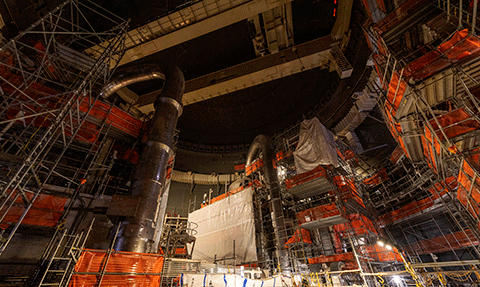 Vogtle Unit 3 containment as of July 2022 photo courtesy Georgia Power
GEORGIA 8/3/2022: Nuclear Watch South remains unequivocally opposed to the Vogtle project and greets the announcement that the NRC has completed its safety review, granting permission to Southern Nuclear to load nuclear fuel in Vogtle 3, with grave trepidation.
Nuclear Watch South Coordinator Glenn Carroll says, "Delays, errors and cost overruns have plagued this failed project from the start of construction. Loading nuclear fuel into this untested reactor design is a risky step that may well proceed similarly, with yet more ominous ramifications upon actual start up. All other such projects have been abandoned -- Nuclear Watch South gives a vote of NO CONFIDENCE to the Westinghouse AP1000 or its construction!"
As the environmental group has been showing since 2015, using Georgia Power's figures published in its annual reports, the power output from this colossal, expensive boondoggle is not needed. Vogtle 3 & 4, if ever brought on line, will add a mere 6-7% to Georgia Power's bloated power portfolio which already is chronically underutilized by an average of 30% per year. The only clear "benefit" to constructing Plant Vogtle has been to pump up Georgia Power's profits and in that regard it has been a whopping success as Georgia Power has made more than $12 billion in profit since Vogtle construction began.
Ms. Carroll observes, "The revelation of tens of thousands of incomplete inspection records going back how far (no one knows ... or at least will say) in the 11th hour leading up to this milestone beggars belief that all aspects of this dangerous reactor have been inspected, tested, and analyzed by the construction contractors, and properly vetted by regulators. It is impossible to overstate how much is at stake when it comes to nuclear safety and if anyone thinks that Chernobyl and Fukushima can't happen here they could be tragically wrong."
Despite Georgia Power's confident announcements, the road to reactor start-up is still long, steep and rigorous. Independent construction monitors have testified that there remains quite a lot of construction that is not on the path to fuel load that must be completed before achieving commercial operation. If and when the nuclear fuel is tested for nuclear criticality, the vast nuclear factory will be irrevocably contaminated, becoming ultimately radioactive waste. Given that power from this expensive white elephant is not needed, Georgians are being tricked into a $30 billion+ obligation that is nothing more than a gratuitous radioactive waste factory putting pressure on an already over-burdened Savannah River and threatening the Georgia countryside and all of its living creatures with the threat of catastrophic radioactive contamination.
Carroll says, "The brief history of nuclear energy includes numerous examples of abandoned reactors. Georgia Power can even now get on the right side of history by abandoning Plant Vogtle and beginning today to deploy solar panels and batteries on the homes and businesses that will use the power. The great state of Georgia deserves a shot at being distinguished for something better than being the last victims of corporate nuclear greed."
Georgia Power Profits on Vogtle
Cost Overruns and Delays
ATLANTA 7/13/22: Georgia Power posted a 6.3% profit in 2021 after writing off $991 million for Vogtle construction cost overruns. The monopoly power company's profits jumped 20% at the commencement of Vogtle construction in 2011 and have steadily increased until ballooning Vogtle cost overruns and delays prompted some large tax write-offs in recent years. According to Georgia Power's annual reports filed with the SEC, the company has made more than $12 billion in profit since Vogtle construction began. Almost $4 billion in Vogtle construction tariffs have been collected, mostly from residential and small business customers during the same time frame.
Nuclear Watch South has been tracking Georgia Power's performance statistics through its annual reports since 2013. The trends illustrated in the data have shown since the beginning of Vogtle 3 & 4 that electricity sales are going down, Georgia Power has significant excess capacity, and that Vogtle 3 & 4 are simply not needed. Georgia Power has obsessively pursued what has now become the most expensive power project in human history, although it has yet to produce any power. The extremely high profits the company's shareholders enjoy have become the obvious reason for the project's continuance against all odds.
Tragically, the powerful five-member Georgia Public Service Commission (PSC) has turned a blind eye to the situation, even stepping outside of legal constraints to cheerlead the nuclear reactor projects. The PSC's mission is to protect the captive public from abuse from the powerful monopoly Georgia Power. Instead, it appears that the PSC has been captured by Georgia Power.
Georgia Power recently filed a 12% rate increase request with the PSC. Already enjoying a guaranteed return on equity of 10.5% Georgia Power seeks to increase this profit mechanism to 11%. It is telling that this request occurs as Vogtle falls behind by one month every month and public power partners which own a majority share of the project are exercising their option to cap their financial commitment.
Nuclear Watch South Coordinator Glenn Carroll says, "It is a crime that Georgia electricity customers are being fleeced for more than $30 billion for unneeded, risky reactors. That Georgia Power is profiting so mightily while turning in a piss-poor performance is tantamount to highway robbery and the sheriff -- the PSC -- is, in essence, holding the stage coach up for them," she said.
"Two of the five commission seats are contested in the coming election," adds Ms. Carroll. "Georgia voters have an opportunity to curb this grand larceny by throwing the bums out!"
Nuclear Watch South has entered the Georgia Power Key Financial & Operating Data into the PSC record each year. Georgia Power has alternately ignored it and sometimes, successfully, moved to strike the data from the record. The company has said that the data is irrelevent, but it has never disputed the data which is, after all, derived from its own submissions to the SEC which are required to be truthful and accurate. Unfortunately, the Georgia PSC does not appear to have any standards at all.
GEORGIA POWER KEY FINANCIAL & OPERATING DATA 2011-2021
GEORGIA POWER PROFITS 2008-2021
GEORGIA POWER SALES VOLUME 2008-2021
GEORGIA POWER CAPACITY UTILIZATION 2008-2021
BULLDOGGING THE BOONDOGGLE
The Song Remains the Same: CANCEL PLANT VOGTLE!!
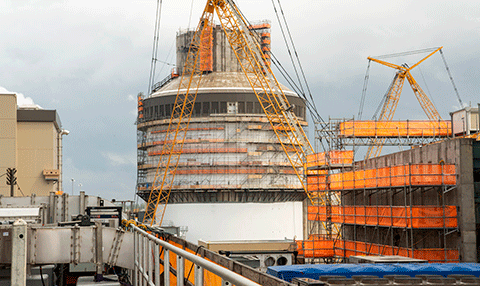 Georgia Power photo from March 2021 shows Vogtle Unit 3 containment still under construction.
ATLANTA 4/30/21: Marking the 35th observance of the ongoing radiological disaster at Chernobyl, Nuclear Watch South released its latest findings on key financial and operating data for Georgia Power, the main owner and lead contractor of still-to-be-finished nuclear reactors on the Savannah River in Georgia.
Since 2013, Nuclear Watch South has been tracking key data from Georgia Power which illustrate the company's actual performance: power demand, power capacity and capacity usage, and profit. With each passing year, the clear trend grows more obvious. Power demand in Georgia is falling an average of 1% per year — even as Georgia's population grew substantially as predicted. Georgia Power is chronically overbuilt by well above 30%, and this is in the wake of shuttering 3,000 megawatts of dirty coal-fired power.
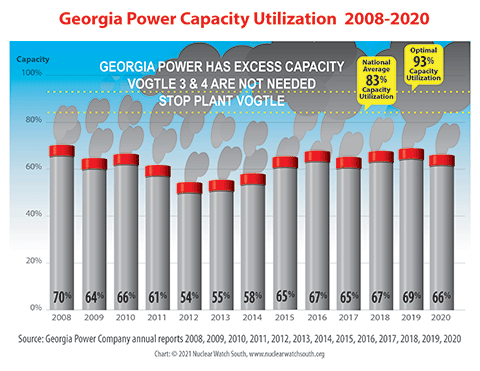
These factors say undeniably that the 7% additional radioactive power that $27-billion nuclear plant Vogtle would dump on the grid is simply not needed.
Nuclear Watch South points out another important finding in Georgia Power's annual reports. Georgia Power's profits have skyrocketed over the 10 years of Vogtle construction. Last year the company posted a 19% profit for its shareholders. Georgia Power has made $12.8 billion in profit since Vogtle construction began in 2011, $4 billion of that profit since the PSC's decision to continue the Vogtle debacle in 2017.
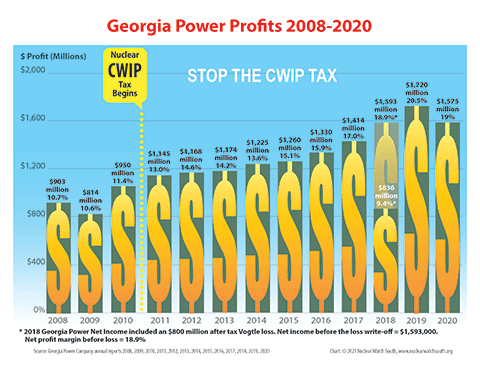
"Georgia ratepayers are not a cash cow for Georgia Power's excessive profit!" declares Nuclear Watch South coordinator Glenn Carroll. "It is totally gross that Georgia Power milked its captive ratepayers for $1.5 BILLION dollars last year while it was cutting services to more than 100,000 customers who couldn't pay their power bill because of the economic disruption of the pandemic."
Georgia Power has for the most part seemed to ignore Nuclear Watch South's data-based campaign to cancel Vogtle construction, but notably, has never denied the accuracy of the figures which are drawn from the company's annual reports filed with the SEC.
This month is also tax season when corporate annual reports are released. And this April, Georgia Power missed its deadline to bring Vogtle on-line, again, five years after blowing the deadline the first time. Yesterday, Southern Company, parent of Georgia-based Georgia Power admitted that the Vogtle construction schedule is slipping even further.
Vogtle reactors 3 & 4 have been under construction, and on Georgia electricity customers' power bills, since 2011. In 2017, more than one year after the original alleged "completion date" the Georgia Public Service Commission (PSC) allowed Georgia Power to continue to build the unneeded reactors in a controversial and irregular decision which doubled Vogtle's cost and construction time, to $27 billion and 10 years.
In the most recent PSC proceeding on Vogtle, an expert for the PSC predicted that the new November 2021 deadline for Vogtle completion would be missed and would likely require $2 billion more and two years longer to complete. The PSC has been right in its predictions 100% of the time in 10 years of Vogtle construction. Georgia Power has been wrong in all of its predictions.
We asked Mark Jacobson, widely recognized renewable energy expert from Stanford University and founder of the Solutions Project with actor Mark Ruffalo, what Georgians could obtain of clean energy with $2 billion and two years. Jacobson informed Nuclear Watch South that $2 billion would capitalize 2,200 megawatts of photovoltaic solar power. Jacobson said that utility-scale solar would be the lowest cost and suggested solarizing unfinished Plant Vogtle to use the transmission grid in place there, and to deploy solar panels on the grid throughout the state on rooftops of schools, buildings, and for shade in parking lots. Nuclear Watch South particularly likes the idea to solarize schools as it is egregious that schools are having money extracted from them to pay in advance for the nuclear reactors. This is a significant burden on cash-strapped public schools.
Jacobson noted that 2,200 megawatts is also the nameplate power output of Vogtle 3 & 4. At peak power, the solar plant would match Vogtle, but he acknowledges that Vogtle has a 90% capacity factor and solar has only 26% of that, but with the addition of battery and other innovative storage technology, that gap narrows. In any event, investing in clean solar power would be far better for Georgia in the long-term than investing in a radioactive waste factory which churns out an unneeded, unwanted product for which there is still no solution 75 years into the Atomic Age.
The anti-nuclear environmental group points to negligence on the part of the PSC which exists to regulate and set rate limits for the monopoly power company. Nuclear Watch South has also pointed out repeatedly that Georgia law empowers the PSC to instantly decertify unneeded power supply. The same law protects Georgia Power from financial penalty from cancelling a project mid-stream, absent criminal negligence, malfeasance or fraud.
"Georgians are being done a great disservice as Georgia Power continues unchecked with its nuclear profiteering scheme," Ms. Carroll says. "The time is NOW for the PSC to pull the plug on Vogtle."
In addition to everything else that has gone wrong on the Vogtle construction project, the coronavirus pandemic hit the Vogtle construction workforce extremely hard. The company reported 2,000 cases through December in its most recent filing to the PSC. Nuclear Watch South is tracking other indicators of the project such as the ballooning costs of construction. In the last six months of 2020, Vogtle construction costs averaged more than $8 million per day. Meanwhile, the company is struggling with its safety review before the Nuclear Regulatory Commission. Despite publishing an ambitious schedule for completing 399 ITAAC (inspections, tests, analyses, and acceptance criteria) by the end of March, there are still well over 200 ITAAC that are incomplete.
"You know, it just doesn't have to be this hard!" Carroll exclaims. "Georgians can simply harvest the sun to meet our energy needs. This is our future and we are ready now."
PR | Nuclear Watch South Calls for Vogtle Cancellation
GEORGIA POWER KEY FINANCIAL AND OPERATING DATA 2010-2020
GEORGIA POWER SALES VOLUME 2008-2020
GEORGIA POWER CAPACITY UTILIZATION 2008-2020
GEORGIA POWER PROFITS 2008-2020
VOGTLE MATH: Numbers Say "Cancel Plant Vogtle"
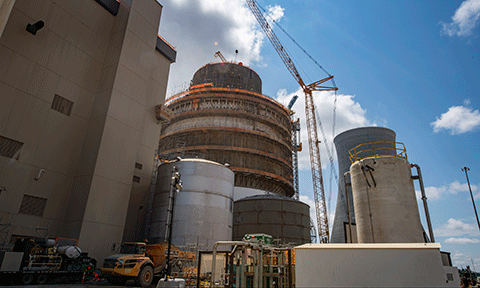 Georgia Power photos from August 2020 show Vogtle 3 construction progress. Rollover image is containment interior. ©2020 Georgia Power
ATLANTA 9/14/2020: Nuclear Watch South released its annual updated performance data culled from Georgia Power’s SEC-filed annual reports today in the wake of the recent filing of Georgia Power’s 23rd Vogtle Construction Monitoring Report (VCM23) to the Georgia Public Service Commission (PSC).
Data from 2009 through 2019, show several clear trends: Georgia Power has an excess of over 30% in its power portfolio and sales have stubbornly remained flat. Vogtle 3 & 4 are simply not needed and should be cancelled concludes the group and its economics expert Steven Prenovitz who compiled and analyzed the figures.
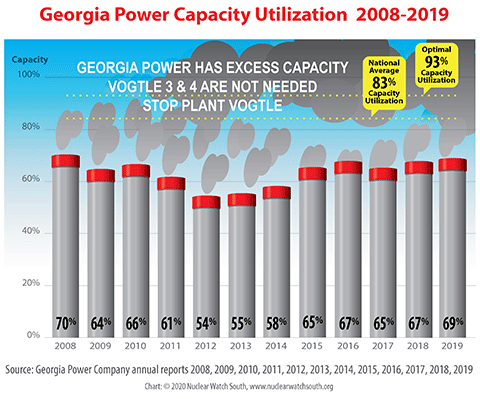
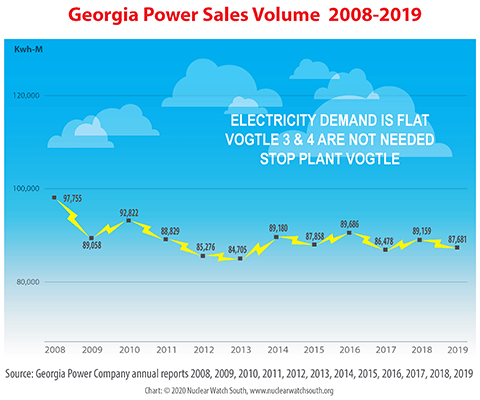
Prenovitz declares, "Given the fact that Vogtle’s meager 1,000 MWs of capacity was never needed (it only increases Georgia Power’s capacity by 6.5%), the fact that Georgia Power’s sales volume has actually declined over the past 10 years, and the fact that costs keep escalating highlights the futility of this endeavor.
"In the past five years, Georgia Power actually reduced its total capacity about 3,600 MWs and yet it still has more than 30% excess capacity," he continues. "So why does Vogtle’s construction continue?"
Vogtle isn't just about making electricity (and radioactive waste) it is mainly about making money for Georgia's most powerful monopoly. Georgia Power’s profits jumped considerably by more than 20% annually when it started construction of the two unnecessary reactors in Burke County. In 2019, Georgia Power posted a whopping 20.5% profit.
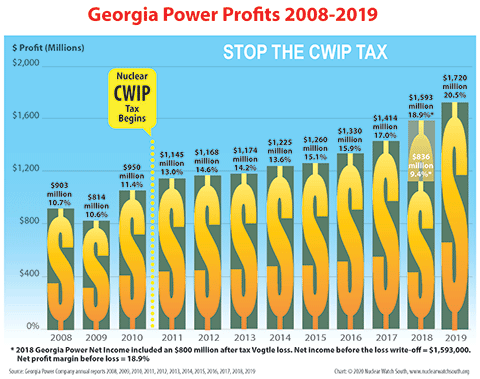
Nuclear Watch South has released Georgia Power’s performance data annually since 2013. Georgia Power and the PSC have routinely ignored the data, but have never refuted it.
Glenn Carroll, coordinator of Nuclear Watch South says, "Vogtle 3 & 4 should be cancelled. Georgia Power simply does not need this $27 billion radioactive white elephant in its portfolio. It has become obvious that the project is a cash cow for this state-regulated, for-profit monopoly.
"The PSC has been grossly negligent in allowing this boondoggle to continue at the expense of the public it is supposed to protect," she continues.
Although the semi-annual proceedings at the PSC are titled "Verification of Expenditures Pursuant to Georgia Power Company’s Certificate of Public Convenience and Necessity for Plant Vogtle Units 3 and 4” Georgia Power and the PSC have obstinately chosen to ignore the big picture and rubberstamp approval of skyrocketing expenditures every six months.
In the most recent VCM23, Georgia Power seeks to recover $701 million spent January-June 2020. That is just Georgia Power’s 45.7% share of Vogtle 3 & 4 construction expenses. On behalf of itself and its rural and municipal co-op partners (or rather the electricity customers of Georgia) it has spent $1.5339 BILLION for the six-month period. This staggering figure amounts to $8.5 million per day.
Georgia Power lays at least some of the blame for rapidly escalating costs on the COVID 19 pandemic. The site has suffered more than 800 cases of COVID between March and end of August 2020. Georgia Power also blames COVID for high absenteeism and the loss of quality craft and management personnel.
In the VCM23, Georgia Power claims to be 87% finished with Vogtle 3 & 4 construction. That figure is doubtful according to PSC Vogtle construction monitors' testimony in VCM22 earlier this summer and by Nuclear Regulatory Commission (NRC) metrics discussed below. Georgia Power has, however, consumed 90% of the budget for Vogtle 3 & 4.
In VCM23, Georgia Power has moved nuclear fuel rod loading for Vogtle 3 from November 2020 to December 2020. The NRC which regulates construction and safety of the nuclear reactors allows delay until June 2021. Nuclear Watch South intervened to oppose fuel load earlier this year. (see story)
Georgia Power's progress on the safety review which precedes regulatory permission to load nuclear fuel is very slow. Georgia Power is the only entity ever to undertake the NRC's new ITAAC (inspections, tests, analysis and acceptance criteria) review process. In order to load fuel, Georgia Power must complete all ITAAC and the NRC must complete its safety review. Only about a third of the Vogtle 3 ITAAC are complete at this point in time.
In April 2020, when Nuclear Watch South challenged the fuel load, Georgia Power still had 277 ITAAC to complete. Since then it has only completed 20 ITAAC, averaging four ITAAC per month. In order to meet its stated goal, Georgia Power must complete 25 to 100 ITAAC per month, a rate which it has never before achieved.
Ms. Carroll says, "It beggars belief that Georgia Power baldly states that it can load fuel in Vogtle 3 in December. It should be a crime that the company is allowed to make such crazy money on the public's dime while lying about the biggest and most expensive project in Georgia history and that our elected officials aid and abet this bad behavior.
"Vogtle should be cancelled. It is not needed and the public should not be forced to fork over one more cent for this radioactive waste factory on the Savannah River," she concludes.
GEORGIA POWER KEY FINANCIAL AND OPERATING DATA 2009-2019
GEORGIA POWER SALES VOLUME 2008-2019
GEORGIA POWER CAPACITY UTILIZATION 2008-2019
GEORGIA POWER PROFITS 2008-2019
Nuclear Watch South Opposes Vogtle 3 Fuel Load
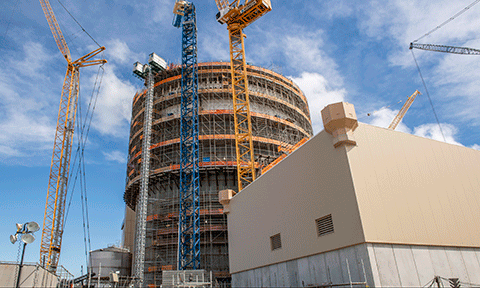 This Georgia Power photograph shows the Vogtle 3 containnent vessel as of March 2020. Obviously, it will not be ready for nuclear fuel in November 2020!
ATLANTA 4/20/2020: Nuclear Watch South has docketed a Petition for Public Hearing with the U.S. Nuclear Regulatory Commission (NRC) in opposition to Southern Nuclear/Georgia Power's request for license to load nuclear fuel into Vogtle 3 reactor in November 2020.
In the petition, which is supported by a civil engineer who worked on the team at Vogtle responsible for ITAAC (inspections, tests, analysis and acceptance criteria), the group contends that the information submitted by Southern Nuclear/Georgia Power is grossly incomplete and insufficient to qualify for review by the NRC.
At issue is the NRC’s novel ITAAC review process which must establish that a new reactor conforms to its design prior to operation. The process provides for public hearing under the Atomic Energy Act and 10 CFR 52.99.
Nuclear Watch South focused on the nuclear island and the shield building in its filing. ITAAC #760 and #761, respectively, are extremely large ITAAC with many elements. They are critical paths to construction completion and the nuclear island walls and shield building provide the primary barrier to radiological releases from the risky reactors. They also contain massive amounts of concrete which requires civil engineer oversight and for which Nuclear Watch South’s expert witness had responsibility during his Vogtle tenure.
Upon investigation it became startling clear that Southern Nuclear/Georgia Power had not provided any substantive information on these vital ITAAC. Close examination showed that of 399 ITAAC filed by Southern Nuclear/Georgia Power, a total of 277, 70% of the total ITAAC, were submitted as Incomplete (UINs). The process allows the filing of UINs but in lieu of finished tests, it is incumbent on the would-be licensee to show how it will obtain data and verify conformance of as-built to design. Nuclear Watch South found that many of the ITAAC UINs indeed satisfied NRC requirements, however, the biggest ones, #760 for the nuclear island, and #761 for the shield building were disturbingly blank.
Background information in the filing details large failures early in the Vogtle construction process which were caught by the NRC and prompted redesign and do-overs. In 2012, construction was halted due to improperly installed rebar. In 2013, the first concrete pour at Vogtle led to a stop work order and an NRC finding of “significant breakdown in the Quality Assurance of [then contractor] CB&I.” These signficant delays at the beginning of Vogtle 3 & 4 construction contributed to the now five-year delay in the project.
More germaine to the ITAAC hearing, however, the filing chronicles a steady reduction in the ITAAC review team following the Westinghouse bankruptcy in 2017. Georgia Power took over as project manager of Vogtle 3 & 4 when Westinghouse exited the nuclear business and, against industry standards, radically reduced the number of ITAAC personnel even as it was ramping up the craft work force to the current 9,000 workers.
When the only remaining civil engineer on the ITAAC team was laid off in 2018, it was unclear how Southern Nuclear/Georgia Power would complete the concrete-related ITAAC. Now Nuclear Watch South has established that they have failed to supply the necessary detailed documentation, indeed ANY documentation, on the nuclear island and the shield building and yet had the audacity to apply for nuclear fuel load with a virtually blank application form.
“Southern Nuclear and Georgia Power appear to have been banking on a Free Pass at the NRC,” says Glenn Carroll, Nuclear Watch South coordinator. “The bar for the ITAAC hearing process is set so high, and the materials are so arcane and voluminous, it appeared impossible to second-guess what they were doing, even though it was ridiculous on its face that Vogtle Unit 3 would be ready for fuel load in November of this year.
“Fortunately,” she continues, “a concerned former insider stepped up to sort through the details and point out that the most important details are simply not there. We believe that by intervening in the NRC ITAAC process we can hold Georgia Power to the regulatory standard to help ensure that Vogtle 3 will be safe if indeed it is ever finished."
The ITAAC review process is an unprecedented new process created by the NRC in 1989, called “one-step licensing,” and designed to bolster the moribund nuclear industry by “streamlining the license process” and “removing uncertainty.” One-step licensing, called Combined Operating License (COL), replaced the licensing process under which the nation’s 114 old nuclear reactors were licensed. The original fleet of reactors were built under a regimen which required a construction license followed by a lengthy review of the completed reactor to establish conformity and safety in order to receive the operating license. For the COL, "Step Two" of the old licensing process has been replaced by the ITAAC process in which every detail of nuclear reactor construction is required to be documented and verified within a numbered record of tests, photos, measurements, etc. and signed off on by engineeers then thoroughly reviewed by NRC staff.
Southern Nuclear/Georgia Power is the first utility to undergo the new ITAAC process required to obtain the operating license and permission to load nuclear fuel. Before its demise following Westinghouse bankruptcy, Summer in South Carolina was on track to be the first to experience the new ITAAC process. Nuclear Watch South is the only petitioner to challenge Southern Nuclear/Georgia Power’s NRC license to load fuel.
The petition was filed in response to a Notice in the Federal Register published February 12, 2020, setting forth the rules of engagement and an April 13, 2020, deadline to petition for a hearing and opportunity to intervene as a party of record.
On April 3, 2020, Nuclear Watch South requested a deadline extension in light of the extreme disruption of the novel coronavirus and pointing to Southern Company’s April 1, 2020, annual 8K filing with the SEC which warned of likely delays to Vogtle construction from COVID-19. In the request, Nuclear Watch South argued that the safety review to establish whether Vogtle as-built conforms with the Westinghouse AP1000 design is not urgent as the Vogtle 3 reactor is still far from complete, and requested the deadline be extended to 60 days beyond the official lift of COVID-19 quarantine.
Nuclear Watch South's request was vigorously opposed by both Southern Nuclear/Georgia Power and the staff of the NRC, although the NRC suggested a one-week extension. The NRC subsequently issued an Order extending the deadline by one week to April 20, 2020.
In the days leading up to Nuclear Watch South’s April 20, 2020, filing, COVID-19 erupted on the Vogtle site with the number of cases mounting from one case on April 6, 2020, to 89 positive cases on April 20, 2020. In addition to several workers having to be quarantined (mandated for the rest of the State of Georgia) with every new positive case, Southern Nuclear/Georgia Power currently intends to lay off 2,000 workers in reaction to the disease outbreak on the Vogtle construction site.
RESOURCES:
Nuclear Watch South Petition for Public Hearing, April 20, 2020
Nuclear Watch South Request for Extension, April 3, 2020
Federal Register Notice, February 12, 2020
VOGTLE 3 & 4 FOR DUMMIES

DOWNLOAD CARTOON FLYER
Georgia Power 2017 performance data shows
17% profit from unneeded Vogtle 3 & 4 boondoggle
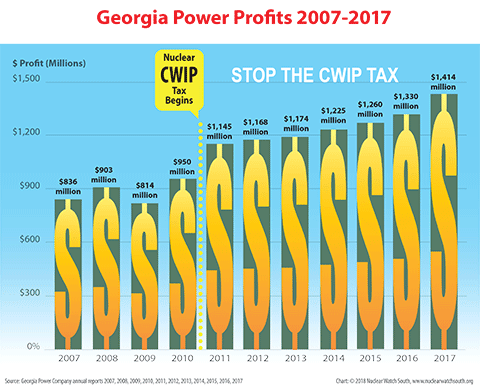
ATLANTA 4/26/18: Nuclear Watch South observes the 32nd anniversary of the Chernobyl disaster by releasing Georgia Power Key Financial and Operating Data 2007-2017 showing that sales are flat, the company is over-built and the reactors under construction at Vogtle 3 & 4 are not needed.
Despite the devastating financial impact of nuclear construction on almost everyone involved, Georgia Power showed a 17% profit in 2017. The regulated monopoly has posted $10.5 billion in profit since 2009. Georgia Power's rising fortunes are well illustrated in the above chart Georgia Power Profits 2007-2017.
Using Georgia Power's own data submitted to the SEC which requires truthful and accurate information (unlike the Georgia Public Service Commission which appears to have no standards), Nuclear Watch South has been able to show, for the past six years since 2013 that power output from Vogtle 3 & 4 is simply NOT NEEDED.
Nuclear Watch South has publicized these findings and placed them into the Public Service Commission (PSC) record for the previous five years and neither Georgia Power Company nor the PSC has challenged or refuted Nuclear Watch South's figures. Both company and regulators have ignored the performance data, clinging instead to disproven electricity demand forecasts.
In addition to the performance data, Nuclear Watch South has repeatedly cited Georgia law which at once empowers the PSC to stop construction on unneeded power supply and protects Georgia Power to recover its investment (absent fraud, malfeasance, etc.)
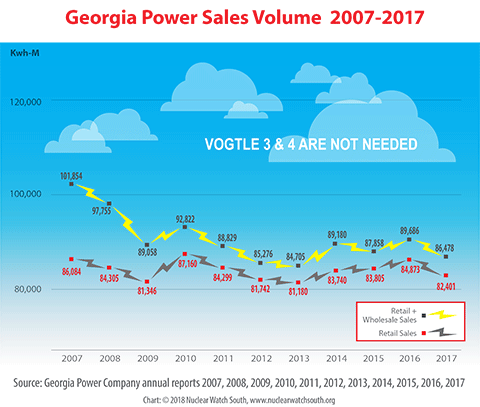
Nuclear Watch South compiled 10 years of Georgia Power indicators from SEC-filed annual reports in order to view historic trends. The above chart Georgia Power Sales Volume 2007-2017 shows that, in startling contrast to Georgia Power forecasts of 4.1% annual growth made in 2008 (revised to 1.2% annual growth in 2016), demand for electricity in actual performance fell by 10% in the past 10 years. Electricity sales fell by 3% last year. The downward trend in electricity demand is part of a global trend.
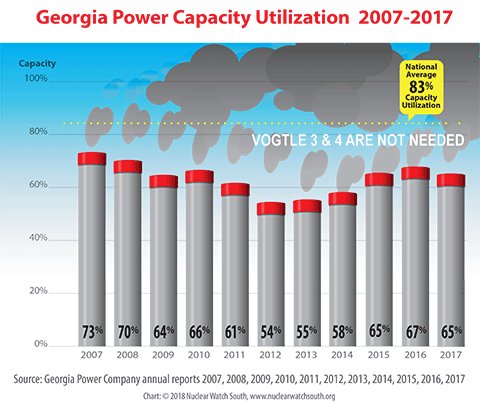
Another important indicator of power demand is Georgia Power's capacity utilization. The above chart Georgia Power Capacity Utilization 2007-2017 shows how much of Georgia Power's existing power portfolio is being used, and not used, as the case may be. Georgia Power is chronically overbuilt, and in 2017 did not use 35% of its available capacity. This figure tracks at about double the national average of 17% excess capacity. Georgia Power's unused capacity remains large despite the recent closure of 3,000 megawatts of coal-fired power. Vogtle 3 & 4, if completed at a cost of $27 billion, would only add 6% capacity to Georgia Power's portfolio, capacity that is not needed, especially at such an extreme cost for inherently risky and increasingly outmoded nuclear energy.
Nuclear Watch South Coordinator Glenn Carroll comments, "Georgia Power's profit motive for stubbornly sticking with the Vogtle 3 & 4 construction fiasco is obvious. They have made $10.5 billion in PROFIT since Vogtle construction began!
"But the mission of the PSC to protect 2.4 million Georgia citizens from a powerful monopoly is equally obvious," she continues. "The PSC is like Dorothy in the 'Wizard of Oz.' They have always had the power to stop construction on an unnecessary power plant."
Following the recent Vogtle hearings at the PSC the price tag to finish the two reactors rose to nearly $27 billion. "We have already spent $10 billion on a very fancy hole in the ground," says Ms. Carroll, "but the smart money for the public is on cancelling the plant and saving up to $17 billion. There are simpler, cheaper, easier ways to get electricity, like wind power and solar power ... if and when we need it.
"Next week hearings start up again about Vogtle construction," she continues. "Another $448 million of the public's money has been squandered on Georgia Power's Vogtle racket in the last six months. It is still a good time to pull the plug on Vogtle 3 & 4.
"It's the Law of Holes," she says. "Stop digging already!"
Thirty-two years ago Reactor #4 at the Chernobyl power station in the Ukraine exploded, burned and melted down. Pripyat, a nearby city of 50,000, has become a literal ghost town. Despite reports that wildlife is thriving in the absence of humans, University of South Carolina researcher Dr. Timothy Mousseau notes that there are fewer animals since the accident and they are suffering. Bird brains are smaller and some male birds are sterile. Rodents are starving because they have cataracts which impair their hunting ability. Vegetation dies and falls but often does not decay because essential micro-organisms have disappeared. The dried material becomes a tinder-box and a forest fire danger. Forest fires spread radiation, enlarging the exclusion zone.
A local dog population of about 250 animals is cared for by the 3,500-strong workforce which is at the Chernobyl site daily but the dogs remain malnourished and don't appear to live longer than four or five years. It is not known if the failure to thrive is from exposure to predators or from increased radiation.
"The financial aspects of Vogtle are outrageous," says Ms. Carroll. "But the real issue is that nuclear power is a monster. We don't know what to do with the waste. The risk of radiological disaster is ever-present. There is no safe level of radiation.
"The good news is that we don't need poison power for electricity. The world is moving past nuclear power and someday Georgia will, too."
REFERENCES
Updated Georgia Power Key Financial and Operating Data 2007-2017
Georgia Power Profits 2007-2017
Georgia Power Sales Volume 2007-2017
Georgia Power Capacity Utilization 2007-2017
Nuclear Watch South Demands Investigation into Possible Engineering Malpractice at Vogtle 3 & 4
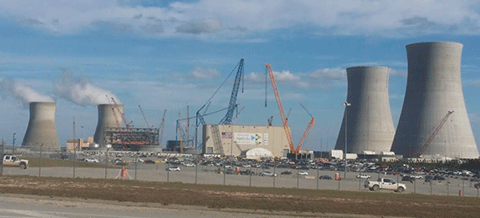 Photo by Gloria Tatum ©2017 courtesy Atlanta Progressive News
ATLANTA 2/9/18: Nuclear Watch South has filed an Amended Request for Investigation with the Georgia Professional License Board of Engineering and Land Surveyors into alleged engineering malpractice at Vogtle 3 & 4. The group originally filed a request in December 2017 and is pressing for action on the serious issue which undermines construction and the ultimate safety of the risky AP1000 nuclear reactors at Vogtle near Augusta, GA.
Concerns stem from a suppressed 2011 internal memo from the AP1000 reactor designer, Westinghouse, which surfaced in the wake of the South Carolina nuclear project, Summer, cancelled in July 2017 after $9 billion had been spent.
The memo raised issues about Westinghouse’s inexperience with managing a mega-construction project and cited several fundamental mistakes the company had made that were causing problems with construction at Summer, and at Vogtle in Georgia. Nuclear Watch South points to concerns that Westinghouse was not having all the drawings for the project reviewed and stamped by licensed professional engineers. The author of the memo cited the importance of the Professional Engineering (PE) seal in ensuring a peer-reviewed, constructible product and representing "an acknowledgement by the Engineer of Record that he/she is willing to certify the safety and reliability of the design.”
Georgia Power responded to Nuclear Watch South’s initial request for investigation in January 2018 admitting that unstamped blueprints were being used and pointing to the “Supremacy Clause of Article VI of the U.S. Constitution” stating its assumption that everything was covered by the U.S. Nuclear Regulatory Commission (NRC) issuing Westinghouse a license for a generic AP1000.
Nuclear Watch South believes that Georgia law O.C.G.A. §43-15-24(a) still stands. It says: “It shall be unlawful … for any private or commercial entity to engage in the construction of any work or structures involving professional engineering which … could adversely affect or jeopardize the health, safety, or welfare of the public unless the plans and specifications have been prepared under the direct supervision or review of and bear the seal of, and the construction is executed under the direct supervision of or review by, a registered professional engineer or architect.”
Nuclear Watch South was shocked to learn, when initiating contact with the Georgia State Professional License Board, that neither Southern Company nor Southern Nuclear Company, has held a valid license to practice professional engineering in Georgia since 2000. This week, the State of Georgia, followed by Georgia Power, dismissed Nuclear Watch South’s concern with respect to the licenses but neither party addressed blueprint practices at Vogtle 3 & 4.
In its Amended Request to the board for investigation, Nuclear Watch South stands on the plain language of the law and states: “it is necessary to possess a valid license to drive a car or get married in Georgia, one would believe the same is true for the design and engineering of nuclear sites and radioactive waste facilities in Georgia. Further investigation by this Board is necessary."
An engineer for the Summer project was quoted in the Charleston Post and Courier article by Andrew Brown “Stamped for Failure” which broke the blueprint story in September 2017 saying: “Blueprints that were issued for construction started showing up with so many flaws nearly every drawing was revised on site … some of those design changes required more paperwork than the original drawings … it was suspected that Westinghouse’s design work was barely outpacing construction. The drawings, the audit found,were “often not constructible."
In its amended request, Nuclear Watch South pointed out that the National Society of Professional Engineers had asked the NRC in October 2017 to investigate the alleged malpractice in South Carolina. As of today, the NRC has still not responded.
In its Amended Request for Investigation filing, Nuclear Watch South says: “Arguments from the company appear to be categorized in one of two categories: (1) ‘We got this’ where ‘we’ is an inexperienced, unlicensed entity that lacks a valid engineering license and/or (2) ‘They got this,’ where ‘they’ are two now-ruined companies, Westinghouse and Stone & Webster and/or the NRC which has not yet spoken to these concerns.”
Until going bankrupt in March 2017, Westinghouse was the lead contractor on Vogtle 3 & 4 which has been under construction since 2010. The project has been plagued with unusable parts, rework and construction delays averaging one day of delay for every day of construction.
When Westinghouse exited the project, Southern Nuclear Company took the role of lead contractor, engaging global construction giant Bechtel as the latest in a series of contractors to attempt to build the ill-fated AP1000 reactors. In its filing, Nuclear Watch South pointed out the infamous blueprint error committed by Bechtel and Westinghouse in Diablo construction from 1977-1981. A flipped blueprint caused improper placement of seismic supports on the California reactor. The error occurred in 1977 but was not discovered until 1981.
Glenn Carroll, coordinator for Nuclear Watch South, says, “It is more than a little disturbing that no one is taking responsibility for engineering practices at Vogtle 3 & 4. Georgia Power is awfully casual about using amateurs to design these multi-billion dollar nuclear power plants that are proving monstrously difficult to construct. We will continue to press for investigation into the engineering problems that are causing construction delays and cost overruns, and very possibly, grave safety threats to present and future Georgians.”
DOCUMENTS
Nuclear Watch South Brief in Support of Professional Engineering Board Investigation into Engineering Malpractice at Vogtle 3 & 4, 2/9/18
Nuclear Watch South List of Exhibits for Engineering Malpractice Brief
Exhibit A:
Original request for investigation of Southern Nuclear Company/
Georgia Power Company, submitted by Nuclear Watch South,
December 12, 2017
Exhibit B:
Southern Nuclear expired license, December 2017
Exhibit C:
Southern Nuclear expired license, February 2018
Exhibit D:
Southern Company - Engineering and Generation Services,
expired license, February 2018
Exhibit E:
Georgia Power Company Response Letter, January 9, 2018
Exhibit F:
“Georgia Power Signs New Contractor for Vogtle Expansion,”
Power Engineering. July 31, 2017.
Exhibit G:
“The Case for Paradigm Shift: An assessment of project delivery
risk against the backdrop of industry practice,”
by M.J. Eveges, PE, August 2011.
Exhibit H:
Westinghouse Memo, 2012
Exhibit I:
“Stamped for Failure,” by Andrew Brown, Charleston Post and Courier. September 24, 2017.
Exhibit J:
National Society of Professional Engineers (NSPE) Letter, October 26, 2017
Exhibit K:
Georgia Professional License ‘Board Matters’ Newsletter, December 2017
State of Georgia response, 2/13/18
Nuclear Watch South response, 2/14/18
Georgia Power response, 2/15/18
U.S. Nuclear Regulatory Commission Response to National Society of Professional Engineers, 2/15/18
Southern Alliance for Clean Energy
Freedom of Information Act Request, 2/23/18
NRC Notice of Violation and Proposed Civil Fine
Letter to Southern Nuclear Operating Company, 2/20/18
Nuclear Watch South 3rd Request for Investigation into
Alleged Engineering Malpractice at Vogtle 3 & 4
50 WAYS TO STOP PLANT VOGTLE
AVIVA sings testimony "50 Ways to Stop Plant Vogtle" for Georgia Public Service Commission at public hearings about Vogtle cancellation on December 11, 2017
©2017 SAVANNAH MORNING NEWS
Tell the Vogtle co-owners:
DING DONG! The nuke is dead!
Which old nuke? The Vogtle nuke!
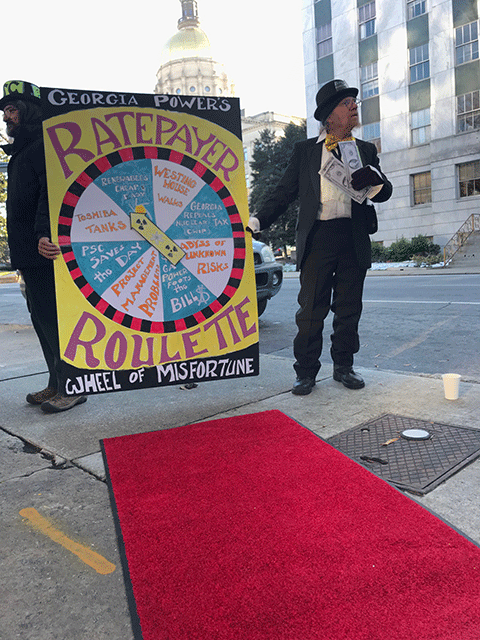
Nuclear Watch South activists Stephen Wing and Tom Ferguson stand with Tom's creative Ratepayer Roulette Wheel of Misfortune outside the Georgia Public Service Commission where the fate of Georgia Power's nuclear construction fiasco Plant Vogtle will be decided on December 21, 2017. Photo by Kelly Jordan.
Take action to encourage Vogtle's co-owners,
the community-based public power co-ops,
to pull the plug on Vogtle 3 & 4 construction!
TAKE ACTION >>
STOP THE PLANT VOGTLE GAMBLE NOW
©2017 GEORGIA GRASSROOTS VIDEO PROJECT
NOW IS THE TIME TO STOP PLANT VOGTLE!

ATLANTA JOURNAL/CONSTITUTION, Tuesday, December 5, 2017
VOGTLE SMACKDOWN AT THE PSC
PUBLIC vs. GEORGIA POWER
 12/11/2017
RALLY, 9:15AM
HEARING, 10AM
12/12-14/2017
HEARINGS, 9AM
Georgia Public Service Commission
244 Washington St.
Atlanta 30334
ATLANTA 12/6/17: Public interest groups and private citizens will converge on the Georgia Public Service Commission in December to confront Georgia Power about its Vogtle 3 & 4 construction fiasco at the 17th Semi-Annual Vogtle Construction Monitoring Review (VCMR). These reviews have occurred roughly every six months since construction commenced on Vogtle 3 & 4 reactors in Burke County in 2010, but this is the first time that Commissioners have officially asked the question whether to cancel the troubled project which is at least five years behind schedule and has doubled in price to $25 billion. The only other reactors under construction in the U.S. were cancelled by South Carolina utilities on July 31, 2017, following the bankruptcy of Westinghouse in March.
Nuclear Watch South, Atlanta Grandmothers for Peace and ARRP (Aging Raging Rate Payers) are holding a rally and encouraging members of the public to speak on the record in the public witness portion of the hearings. Public witness testimony will be accepted at the beginning of each morning and each afternoon session. The PSC has scheduled four days of hearings instead of the usual one day to accommodate a dozen Georgia Power witnesses and a growing roster of intervening parties. The hearing on Monday, December 11 will commence at 10AM and subsequent days will convene at 9AM.
Nuclear Watch South is intervening in the proceeding. In previous interventions, the group has presented expert witness testimony that the power from Vogtle 3 & 4 is not needed using Georgia Power's own performance figures. The Georgia Power data, which the company has never refuted, shows that sales remain flat over almost 10 years, and that the company is chronically overbuilt, currently with 30% excess power in its portfolio despite the recent closure of 3,000 Mw of coal-fired power. Nuclear Watch South also uncovered the disconcerting fact that Georgia Power's profits jumped 20% with the advent of Vogtle construction to more than $1 billion per year. The company has famously collected $2 billion in upfront charges from its residential, small business, local government and school customers for Vogtle which is only 30% complete although it was supposed to be online by now.
This week's hearings include the chance to cross-examine Georgia Power witnesses on their testimony and supporting documents. Nuclear Watch South Coordinator Glenn Carroll says that despite Georgia Power's highly publicized conviction that continuing Vogtle 3 & 4 construction is in the interest of its electric customers, the company doesn't make a convincing case.
She cites the Monte Carlo method of risk analysis used by accounting firm PricewaterhouseCoopers and the weak finding that there is only a 70% probability the Vogtle project can be finished on time and within budget. The analysis was made using only data which was supplied by Georgia Power and Southern Company.
Ms. Carroll says, "The SEC doesn't allow registered investment representatives to use the Monte Carlo method in advising clients, yet Georgia Power is using it to advise the PSC to gamble billions of our hard-earned dollars on the nuclear construction fiasco at Vogtle. Do they really think the public is foolish enough to want to gamble another $15 billion on this losing proposition when the odds of success are only 2 out of 3?"
Nuclear Watch South and other parties have the right to present expert witnesses in a second set of hearings scheduled for December 11-14, 2017. But Ms. Carroll observes that key witnesses for Georgia Power in the current set of hearings present strong evidence that Vogtle should be cancelled. Risks cited by the witnesses include: potential bankruptcy of Westinghouse parent company Toshiba; unfinished design work by Westinghouse which is still in bankruptcy; continuing construction and supply problems; and failure to secure production tax credits extension.
Nuclear Watch South is concerned about the sparse analysis submitted by Georgia Power in response to the PSC's request for information about the cost of cancellation. Georgia Power submitted reams of analysis in support of continuing construction, but less than 100 pages about cancellation. Outright cancellation is not presented at all. The cost of deferral, which is presumed to mean mothballing and securing the site to retain the option to complete in the future, seems attractive at $140 million but the witnesses barely mention it, instead presenting an elaborate and expensive scenario in which the construction site is completely dismantled, landfilled, and the former 40-acre longleaf pine forest made into a "greenfield" for a colossal price tag over $700 million.
The environmental group is also concerned about reports that the company is seeking to sell its $3.7 billion commitment from Toshiba to investors.
Ms. Carroll says, "Southern Company needs to cease and desist from its efforts to raise cash using the $3.7 billion compensation package promised by Toshiba on the failed reactor project. That is the public's money! We need that to pay back the DOE loan and soften the blow of the $10 billion squandered on the unneeded Vogtle reactors. Someone, the PSC, needs to nip this most recent insult to injury in the bud!"
Consumer advocacy group ARRP is focused on the nuclear construction surcharge on electricity customer's bills. The unprecedented 10% upfront charge was legalized in 2009 with passage of the Georgia Nuclear Energy Financing Act, also known as CWIP (Construction Work in Progress) and is listed on Georgia Power bills as NCCR (Nuclear Construction Cost Recovery).
ARRP's Robert Searfoss says, "One million dollars a year has been paid for the Vogtle mess by the Atlanta Public Schools alone. Think of schools all over the state paying a surcharge into this money pit. The Vogtle money pit is taking more money from schools than all the PTA bake sales bring in. Georgia Power and its partners should be embarrassed to be taking millions of dollars of school money. It is frankly shameful. The law needs amending so the power companies can't take any more school money for Vogtle. My school tax money is for local school needs, not for Georgia Power and Southern Company profits."
Atlanta Grandmothers for Peace works to promote social justice on behalf of young people. The group is concerned not only about the financial burden on the future from Vogtle 3 & 4's gargantuan price tag which customers would have to repay for the next 60 years, but with the grave environmental and health risks posed by nuclear energy.
Atlanta Grandmothers for Peace activist Minnie Ruffin says, "Nuclear reactors are the scariest of all monsters. One bad day at a nuclear reactor can poison the whole state and all of its inhabitants for centuries. Every nuclear reactor produces 20 tons of high-level radioactive waste every year — waste which will be hazardous for at least 250,000 years — and we still don't have a solution for it. Thankfully we don't have to place that risk and burden on our children because the sun and wind have become cheaper and easier to build than nuclear."
She concludes, "Truly clean natural energy from the sun and the wind is what we want for our children's future."
VOGTLE SMACKDOWN FACT SHEET
VOGTLE SMACKDOWN PRESS RELEASE
Nuclear Watch South files to force the PSC to deal with request for emergency hearing
 ATLANTA 6/22/17: Georgia environmental group Nuclear Watch South filed a Mandamus Motion to Compel Response to Request for Emergency Public Hearing on Vogtle 3 & 4 with the Georgia Public Service Commission (PSC) yesterday evening, June 21, 2017. The State Attorney General Chris Carr was also served the motion.
In its motion Nuclear Watch South asserts that the PSC is out of compliance with regulations requiring the Commission to make a timely and definite response to a legitimate public request. The regulation is very specific, and the PSC should have placed Nuclear Watch South’s original Request for Emergency Public Hearing on the agenda of its regularly scheduled May 9, 2017 meeting, or specified an alternative date to consider the request. When the PSC failed to respond to Nuclear Watch South’s initial request within 30 days, the group issued a Motion to Compel a Response on May 19, 2017, which received only a brief e-mail acknowledgement from the PSC staff on May 25, but did not set a date to hear Nuclear Watch South’s request. (The e-mail is included in the Mandamus Motion.)
When the PSC ignored both legitimate petitions filed by Nuclear Watch South, the Mandamus Motion became the only recourse to pressure the PSC to perform its regulatory function as described by Georgia law. The Mandamus states: "the PSC’s inaction places the PSC in flagrant violation of Georgia PSC Rule 515-2-1.05 which regulates the PSC's response to the public and establishes a standard for timely response to a legitimate request."
The request for emergency public hearing was made in light of the PSC’s lack of response to the extraordinary circumstances clouding the future viability of the Vogtle 3 & 4 construction project. Nuclear Watch South is very concerned about the many millions of dollars that are extracted from the public each and every month and transferred to Georgia Power as real profit.
Glenn Carroll, Nuclear Watch South coordinator says, "It has been six months since the financial ruination of Georgia Power’s Vogtle construction consortium partners, Toshiba, Westinghouse, CB&I, et cetera, came into the global spotlight, and in that time, $250 million has been collected and transferred from Georgia Power’s captive customer base to Georgia Power’s shareholders as profit. The PSC has taken ZERO action of any kind since this financial quagmire started, and we demand that our reasonable request for an emergency public hearing be put on their agenda."
Nuclear Watch South has been testifying for years that Vogtle 3 & 4 are not needed because Georgia Power is overbuilt in a shrinking electricity market. The group has also highlighted the fact that Georgia Power’s profits have been skyrocketing at a similar rate to Vogtle’s cost overruns and that the project suffering from “infinite delay," a day of delay for every day it is under construction.
Recent testimony submitted by the PSC staff that says it has become uneconomic to complete Vogtle and that the project remains mired in delay are cited in the document.
The Mandamus Motion complains that Georgia Power is, de facto, controlling the PSC’s calendar, a fact which is underscored by the e-mail sent by the staff which says, "Georgia Power Company has not yet filed its revised cost and schedule estimates for Units 3 and 4, nor has the Company indicated what type of filing it may ultimately make at the Commission. Once the Company provides its updated projections, Staff and Intervenors will be in a better position to respond, as may be appropriate.” Nuclear Watch South points to the statement as an example of the PSC’s attitude which has led it to be out of compliance with its own laws.
Nuclear Watch South’s irritation with the PSC’s disdain for the public is evident in its response via the Mandamus Motion: “… public witnesses, who, unlike the rich monopoly Georgia Power (which the PSC regulates), are rudely interrupted and shut down if their remarks exceed three minutes. Public witnesses, ordinary citizens who take time off work to come to obscure, poorly noticed, PSC hearings, often suffer hostile challenges to their testimony and written comments from the Commissioners.”
The grassroots environmental group is asking for an emergency public hearing to specifically discuss the situation surrounding the bankruptcies and revelations of additional costs, delays and challenges to moving forward with the unneeded Vogtle 3 & 4 reactors. Next week, on June 29, the PSC will hold hearings in the 16th Vogtle Construction Monitoring Review. Glenn Carroll will testify that Vogtle 3 & 4 are not needed and it would be cheaper to cancel the project.
DOCUMENTS
MANDAMUS MOTION TO COMPEL RESPONSE TO
REQUEST FOR EMERGENCY PUBLIC HEARING ON VOGTLE 3 & 4
MOTION TO COMPEL RESPONSE TO REQUEST FOR
EMERGENCY PUBLIC HEARING ON VOGTLE 3 & 4
REQUEST FOR EMERGENCY PUBLIC HEARING ON VOGTLE 3 & 4
Nuclear Watch South files direct testimony in 16th Vogtle Semiannual Review
ATLANTA 6/8/17: Nuclear Watch South filed the expert witness testimony of Glenn Carroll this afternoon with the Georgia Public Service Commission in the 16th Semi-Annual Vogtle Construction Monitoring Review.
Ms. Carroll’s testimony drives home the point that Vogtle 3 & 4 power are not needed and Georgia law authorizes the Public Service Commission to decertify unneeded power supply. Updated charts of Georgia Power performance data 2006-2016 are included as well as a new report from the Southern Environmental Law Center which also concludes that Vogtle 3 & 4 are not needed. (scroll down to see charts)
Ms. Carroll stresses that the PSC has taken no action at all since the bankruptcies of Georgia Power’s Vogtle construction consortium partners and the last action taken “remains the December 22, 2016, decision to virtually extend Georgia Power’s blank check to built Vogtle 3 & 4 despite the cost overruns, delays, and failure of the project to meet the necessity test.”
DOCUMENTS
Nuclear Watch South 16th VCMR Direct Testimony Glenn Carroll
Glenn Carroll Resume 2017
Georgia Power Key Financial and Operating Data 2006-2016
Plant Vogtle Decision Point: Time to Chart a Different Course
Coalition of Citizen Groups Rally to Give PSC Message: "Not One More Cent for Vogtle!"
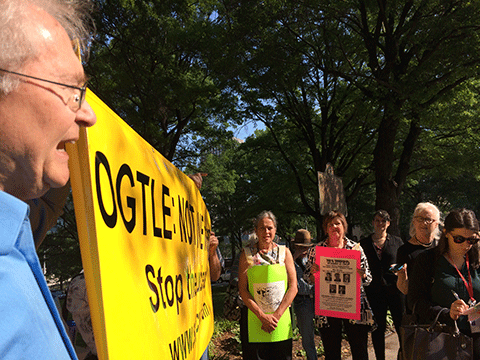 PHOTOS © 2017 Betsy Rivard
ATLANTA 5/12/17: Nuclear Watch South hosted a press conference with Georgia WAND (Women’s Action for New Directions), Atlanta Grandmothers for Peace, ARRP - Aging Raging Rate Payers and Concerned Ratepayers of Georgia prior to the Georgia Public Service Commission's (PSC) first public hearing since high-profile bankruptcies beset the Vogtle construction consortium. The hearing was part of the 16th Semi-Annual Vogtle Construction Monitoring Review process. The next scheduled public hearing on Vogtle will be on June 29 when PSC construction monitors will testify for the PSC staff and Nuclear Watch South will also present expert testimony calling for the shutdown of Vogtle 3 & 4.
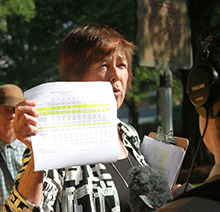 Kicking off the press conference, Nuclear Watch South Coordinator Glenn Carroll said, “Georgia Power’s own data have shown for many years that Vogtle 3 & 4 are not needed. Now, when the companies building the reactors are failing and the unfinished project is only one-third complete, is the perfect time for the PSC to ‘decertify’ Vogtle for failure to meet the public necessity test. The PSC needs to seize control of this situation which has been languishing for five months already. During that time Georgia Power customers have shelled out another $100 million in nuclear taxes. The PSC has full power and authority from the State of Georgia to occupy Georgia Power's offices, to subpoena anything it needs from the company to get to the truth of the matter. It is high time to call Georgia Power’s hand and stop their big bets with other people's money.”
The groups called for the PSC to grasp and use its authority to subpoena information from Georgia Power and move rapidly to protect Georgia ratepayers from continued payments of $23 million per month from consumers to Georgia Power via the CWIP (Construction Work in Progress) tax AKA Nuclear Construction Cost Recovery tariff.
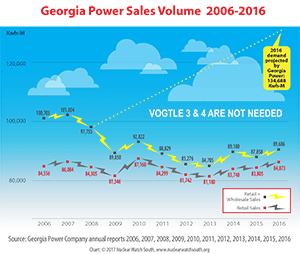 Nuclear Watch South is a legal intervenor on the Vogtle docket at the PSC and brought updated Georgia Power performance figures for distribution at the hearing. Analysis of 10 years of Georgia Power data shows that power from Vogtle 3 & 4 is not needed as electricity demand is down overall and the company has one-third of its power portfolio idled in reserve. Neither Georgia Power nor the PSC staff have ever refuted the data which was first presented in 2014. Yesterday Sue Stoudemire entered the data into the public record with dynamic testimony that also included complaints about the PSC's holding 10AM, Thursday meetings which are impossible for most working people to attend.
Concerned Ratepayers of Georgia and Steven Prenovitz are also legal intervenors on the Vogtle docket. Georgia Power's witnesses testified following the public witnesses and Prenovitz cross-examined them for many hours, unfazed by the onslaught of objections from Georgia Power lawyers and all five commissioners.
Prenovitz pried important admissions and inconsistencies out of the witnesses. A significant contradiction lies in Georgia Power's testimony under oath yesterday that they did not know that Westinghouse was heading for bankruptcy. That testimony is in stark contrast to Georgia Power's lawyer, Kevin Greene of Troutman Sanders, assertion a month ago that Georgia Power was aware and well prepared for the Westinghouse bankruptcy.
Prenovitz also succeeded in getting the company to admit it had fallen another four months behind. He repeatedly challenged the company's claim of good managerial oversight of the Vogtle project in light of the obvious financial failure of the company's Vogtle project partners, Toshiba, Westinghouse and the CB&I/Shaw/Stone and Webster construction company.
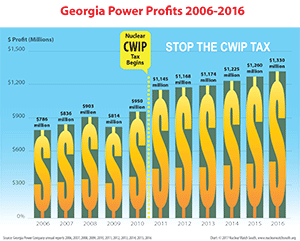 ARRP - Aging Raging Rate Payers founder Robert Searfoss strongly confronted the commission which cut him off in mid-sentence at the three-minute mark. He had certainly wasted no time getting to the point, however, saying, "I am an elderly customer caught in the Vogtle Vortex. In four months I’ll be 72 and have already had enough of my money taken to support a profitable power company’s new plant. My money is being taken every month while the company paid its C.E.O Mr. Fanning over $52,000 each workday last year. Over 14 million dollars last year. Over 14 million dollars. While the company took money from elderly people." Read Robert Searfoss' entire tesimony.
Atlanta Grandmothers for Peace are members of the Stop CWIP Coalition and share ARRP concerns about the impact on the elderly to pay the nuclear construction tax for a service they do not need and may never receive. Acgtive grandmother Betsy Rivard says, “We object to the grave injustice of Georgia ratepayers and U.S. taxpayers footing the $10 billion bill for Vogtle, a power source that is not even needed. We are also deeply concerned for future generations. If Vogtle construction continues according to the plan, which is now obviously off-track, our grandchildren will still be paying for two unneeded radioactive waste factories when they are old and gray. At this point, we have a moral obligation to stop the construction of Vogtle 3 & 4.”
Southern Environmental Law Center issued a timely report on Georgia's energy picture providing independent confirmation to Nuclear Watch South's claim that Vogtle 3 & 4 are not needed. The report concludes that Georgia Power does not need any new power supply until 2030 and that they are doing a good job retiring coal and adding renewables to its portfolio. It recommends abandoning Vogtle 3 & 4 before more money is spent and to continue pursuing the course of efficiency and renewables.
Nuclear Watch South recently filed a formal request with the PSC to hold an emergency public hearing about Vogtle's construction future, and to give Georgia Power a deadline to file information pertinent to deciding the future of Vogtle 3 & 4 construction. In testimony yesterday, Georgia Power indicated it would file the information in June which would satisfy part of Nuclear Watch South's request for a June 30, 2017, deadline.
RESOURCES
UPDATED GEORGIA POWER KEY FINANCIAL AND OPERATING DATA 2017
GEORGIA POWER SALES VOLUME 2006-2016
GEORGIA POWER CAPACITY UTILIZATION 2006-2016
GEORGIA POWER PROFITS 2006-2016
PRESS RELEASE
ROBERT SEARFOSS TESTIMONY TO PSC 5/11/17
SOUTHERN ENVIRONMENTAL LAW CENTER
Plant Vogtle Decision Point: Time to Chart a Different Course
NOT ONE MORE CENT FOR VOGTLE
Nuclear Watch South files request for emergency public hearing with Public Service Commission on Tax Day
©2017 GEORGIA GRASSROOTS VIDEO | JUDY CONDER
WATCH: "NOT ONE MORE CENT FOR VOGTLE" ON YOUTUBE
ATLANTA 4/19/17: Yesterday Nuclear Watch South filed a Request for Emergency Public Hearing on Vogtle 3 & 4, demanding that the PSC set a schedule and require Georgia Power to submit information that has previously been withheld from the public such as the construction schedule, the cost to cancel and the cost to complete the beleaguered reactor project.
E-mail or call the Georgia Public Service Commissioners and ask them to hold an emergency public hearing before Georgia Power blows any more of OUR MONEY on its risky high-stakes nuclear bet!

DOUG |
TIM |
CHUCK |
STAN |
BUBBA |
|---|
TAX DAY PROTEST
Tell the PSC: NOT ONE MORE CENT FOR VOGTLE
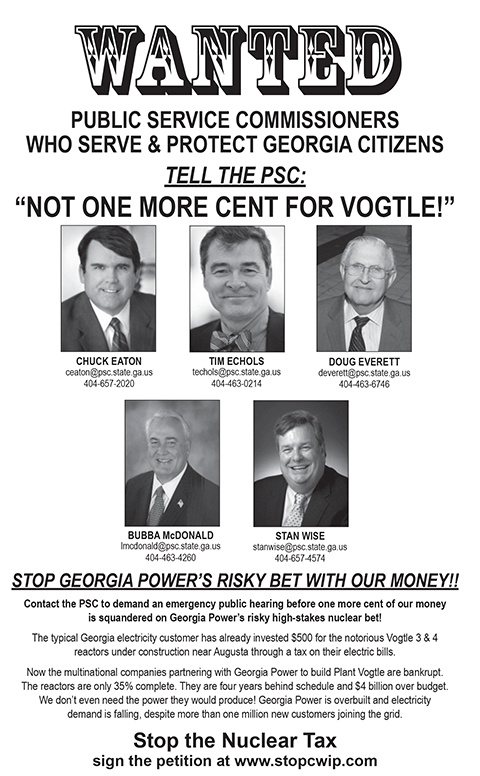
Join the press conference!
9:30 AM, Tuesday, April 18, 2017
244 Washington Street SW, Atlanta
ATLANTA 3/18/17: Nuclear Watch South is holding a press conference on Tuesday April 18, 2017, the deadline for filing 2016 federal and state income tax returns to draw attention to the “invisible” tax levied on all Georgia Power rate payers through surcharges on monthly power bills for Construction Work In Progress (CWIP). The press conference will take place at 244 Washington Street, S.W. Atlanta at 9:30 a.m. before the Georgia Public Service Commission (PSC) holds its regular Administrative Session at 10 a.m.
Nuclear Watch South has testified that Vogtle 3 & 4 are not needed as a generating source since before concrete was poured for the reactor expansion project, and before the Vogtle construction consortium began suing each other in court. The group's findings are based on Georgia Power’s annual report performance figures, which show the company has been experiencing a downturn in sales and a large excess capacity for the past 10 years. Georgia Power has not refuted Nuclear Watch South’s analysis. Vogtle, if completed, would add 6% capacity to Georgia Power's already bloated portfolio.
Given the global imbroglio that Vogtle 3 & 4 has become, bankrupting three 100-year-old global companies, the group has staked out Tax Day to submit a formal request for an emergency public hearing to the PSC and to seek relief from the upfront tax Georgia electricity customers have been required to pay for the ill-fated Vogtle project.
“Georgia Power has been making a risky high-stakes bet on nuclear energy with the public’s money,” explains Glenn Carroll, coordinator of Nuclear Watch South. “The situation warrants an emergency public hearing to stem the hemorrhaging of public money for the unneeded, deeply troubled Vogtle project. Georgia Power and the PSC have both acknowledged the seriousness of the situation, but no dates or procedures have been set for confronting the issue.”
Atlanta Grandmothers for Peace are members of the Stop CWIP Coalition which is working to repeal the 2009 law that enables Georgia Power to charge rate payers Construction Work in Progress (CWIP) AKA Nuclear Construction Cost Recovery charges on monthly power bills. The average electric customer in Georgia has been forced to invest $500 so far in the reactors which are only 36% complete, four years behind schedule and $4 billion over budget.
“We have a moral obligation to the future,” says Atlanta Grandmothers for Peace President Bernice Bass. “If we set up gratuitous radioactive waste factories we recklessly threaten future generations. And,” she continues, “we would also condemn our grandchildren who are not even in school yet, to a lifetime of payments for those monsters!”
Senior electric customers have been complaining to the PSC for years about being forced to pay for something that may not come on-line until after they are dead. “This profitable company has been picking my pocket for several years to build their plant,” says disgruntled Georgia Power customer Robert Searfoss, 71, of Atlanta. “Let those executive fat cats use their own money to finish this if they want to. Not one more cent of my money to build their plant!”
Copies of the hearing request will be available at the press conference and online after the Tuesday morning filing.
NUCLEAR WATCH SOUTH REQUEST FOR EMERGENCY PUBLIC HEARING
Westinghouse Implodes, Vogtle Cancellation Likely?
Timeline of a Boondoggle: Vogtle 3 & 4
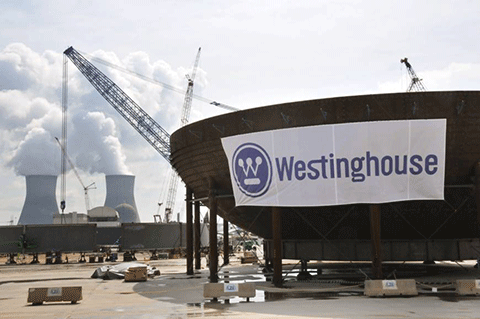
3/29/17 ATLANTA: In the wake of Vogtle lead contractor Westinghouse's bankruptcy announcement yesterday, coupled with Toshiba's revelation that it is $9.9 billion in debt from the four reactors under construction in the U.S. (two in Georgia, two in South Carolina), Atlanta-based environmental group Nuclear Watch South is issuing a detailed timeline of Vogtle 3 & 4 milestones and missteps.
Nuclear Watch South Coordinator Glenn Carroll articulated the group's position in a brief statement:
 "Georgia's legislators and Public Service Commissioners enabled Georgia Power to obtain $2 billion in up-front charges from its customers which has increased Georgia Power's profit margin by over 20% in the Vogtle construction years.
"Vogtle owners have borrowed another $8.3 billion of U.S. taxpayer money from the U.S. Department of Energy (DOE). It is unclear how the money can be paid back since it is increasingly likely that Vogtle will not ever be built, but, at a minimum, Georgia Power should not be allowed to keep its windfall profits at the public's expense.
"A full investigation and accounting needs to be done as to where this mind-boggling amount of public money has been spent with so little to show for it as Vogtle is still only 36% finished after six years under construction.
"As the revelations unfold of how breathtakingly out-of-touch several large multinational companies are with their own operations, purchases, and accounting, we are very lucky that these inept actors were unsuccessful in placing their product, two colossally dangerous radioactive waste factories, in the Georgia landscape.
"It is time to stop wasting time, energy and money on Vogtle 3 & 4 which aren't needed anyway. Our renewables future is close at hand. It is time to get on with it."
 Points of interest in the timeline:
• Construction stalled until 20 months after the U.S. Nuclear Regulatory Commission (NRC) issued the license for Vogtle 3 & 4 in 2012. (NRC stops construction due to improperly installed concrete.)
• 2013, Nuclear Watch South testified in the 8th Vogtle Construction Monitoring Review (VCMR), using data obtained from Georgia Power annual reports, that Vogtle 3 & 4 were not needed because Georgia Power's sales had gone flat for several years and the company was chronically overbuilt. Expert testimony advised that it would be cheaper to mothball construction until the market leveled out, or to cancel the project outright as Georgia Power was legally entitled to recover expenses if a certified plant were to be cancelled.
• Five days later (2013), Westinghouse and Georgia Power went behind closed doors to sue each other. (It would be two years before Westinghouse would go public with their settlement agreement in 2015, setting into motion the dramatic revelations and events of recent weeks.)
• Four weeks after Nuclear Watch South's testimony, November 2013, the first concrete was poured at Vogtle 3 & 4 in November 2013.
• One month after construction starts, December 2013, the NRC finds significant breakdown in Quality Assurance at CB&I
• December 2014, PSC construction monitors testify that it is "imprudent" to proceed without an Integrated Project Schedule (which we still do not have)
• 2016, Nuclear Watch South testifies in the 14th VCMR that Georgia Power is making historic profits on Vogtle construction and it would still be cheaper for consumers to cut losses by cancelling Vogtle construction
TIMELINE: CHRONOLOGY OF VOGTLE 3 & 4
2009
February - Georgia legislature passes Georgia Nuclear Energy Financing Act AKA SB31, CWIP (Construction Work in Progress), NCCR (Nuclear Construction Cost Recovery); March - Georgia Public Service Commission approves Vogtle 3 & 4 for $14 billion; April - Georgia Power gives green light to Westinghouse and Shaw (formerly Stone & Webster) to start clearing 40-acre endangered longleaf pine forest; August - NRC issues Early Site Permit; October - NRC demands design revision for AP1000 shield building; December - construction monitors testify in 1st Vogtle Construction Monitoring Review VCMR) that delays are likely due to NRC revisions
2011
1/1/11 Georgia Power begins charging Nuclear Construction Cost Recovery tariff on small business and residential power bills; 3/11/11 Fukushima earthquake and tsunami cause explosions and meltdowns of Fukushimi Dai-ichi 1, 2 & 3; 8/9/11 Westinghouse AP1000 design receives final NRC approval (note: no post-Fukushima changes are required)
2012
2/9/12 NRC issues Georgia Power combined operating license for Vogtle 3&4; April - NRC stops work due to improper rebar installation; December - reactor vessel nearly falls off train near Port of Savannah
2013
February - CB&I buys Shaw for $3 billion; 2/23/13 Rumor that CB&I will buy Westinghouse; 10/15/13 Nuclear Watch South proves before Georgia PSC that Vogtle is not needed and it would be cheaper to stop construction in the 8th VCMR; 10/20/13 Westinghouse/CB&I & Georgia Power begin litigation; 11/13/13 First concrete poured for Vogtle 3 & 4; December - NRC finds a “significant breakdown in the Quality Assurance Program of CB&I”
2014
Litigation continues between Westinghouse/CB&I and Georgia Power
February - DOE loan guarantees approved; September - Georgia Power reports 5,000 workers at Vogtle 3 & 4; December - PSC monitors testify “imprudent” to proceed without Integrated Project Schedule in the 11th VCMR
2015
Litigation continues between Westinghouse/CB&I and Georgia Power
August - SACE submits to PSC that the total cost of Vogtle to consumers will be $65 billion; October - Westinghouse & Georgia Power settlement on cost overruns; Westinghouse buys CB&I for $229 million; December - Georgia Power blocks Nuclear Watch South testimony about its Vogtle profits in the 13th VCMR
2016
February - GA PSC agrees to unprecedented mid-project prudency review of cost overruns; March - Fluor takes over as Vogtle construction manager; 4/1/16 - Vogtle 3 deadline is missed; 4/16/16 - 5,500 workers on site; 6/30/16 - Nuclear Watch South testifies before PSC that Georgia Power is making historic profits on Vogtle at the expense of Georgia ratepayers in the 14th VCMR; 7/26/16 - CB&I sues Westinghouse over $2 billion closing agreement; 12/20/16 - GA PSC approves $2 billion in cost overruns, boosting Vogtle price-tag to $18 billion; 12/27/16 - Toshiba announces $3 billion write-down for nuclear division
2017
2/14/17 Toshiba announces $6 billion nuclear write-down; 3/9/17 Westinghouse bankruptcy rumors; 3/14/17 Toshiba announces $9 billion nuclear write-down; 3/21/17 Fluor files lien against Georgia Power; 3/28/17 Westinghouse announces bankruptcy, Toshiba announces $9.9 billion nuclear write-down
REFERENCES
KEY GEORGIA POWER FINANCIAL AND OPERATING DATA 2005-2015
GEORGIA POWER SALES VOLUME 2005-2015
GEORGIA POWER CAPACITY UTILIZATION 2005-2015
GEORGIA POWER PROFITS 2005-2015
FLUOR LIEN AGAINST GEORGIA POWER/SOUTHERN NUCLEAR
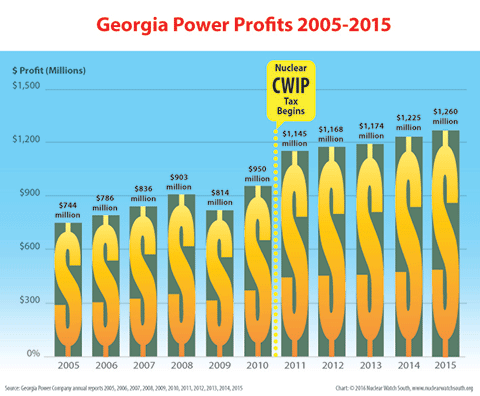
STOP PLANT VOGTLE
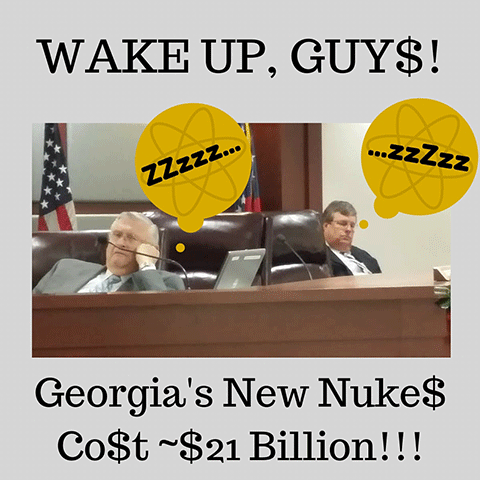
READ THE FORBIDDEN NUCLEAR WATCH SOUTH TESTIMONY
READ THE STORY ON THE SLEEPING REGULATORS
Fear and Loathing at the 14th Semi-Annual Vogtle Construction Monitoring Review
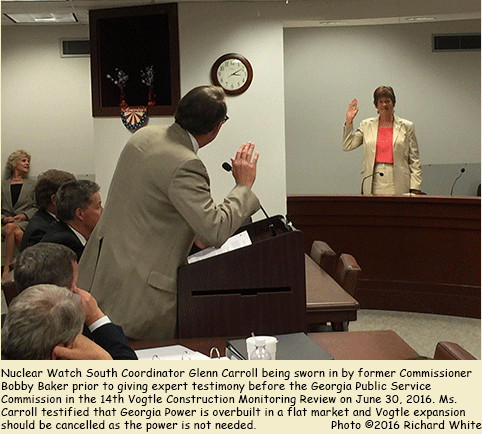
ATLANTA 6/30/16: Only three of five elected Georgia Public Service Commissioners showed up to hear a gloomy forecast from its advisory staff, the Public Interest Advocacy construction monitors and economist that work for the PSC.
Nuclear Watch South Coordinator Glenn Carroll testified to the Georgia Public Service Commission that according to Georgia Power’s own information filed in annual reports with the SEC, Vogtle 3 & 4 do not meet the necessity test for additional capacity resource.
“Back in 2009, Georgia Power predicted it would need new base load power by 2016,” says Ms. Carroll. “Now 2016 is here, and Georgia Power’s electricity sales are the same as they were back then.”
Georgia Power profit data show, however, that Georgia Power’s profits have swelled enormously in the years that Vogtle has been under construction, coinciding with collection of the Nuclear Construction Cost Recovery tariff from residential and small business customers.
Says Carroll, “We hope to impress upon the Public Service Commissioners that to continue construction of Vogtle 3&4, which is only 1/3 finished, and only 1/3 paid for, will harm the public, but that cancelling Vogtle 3&4 will benefit the public by saving twice what has already been sunk into the unneeded capacity resource."
Carroll's testimony was given following a day of disturbing testimony from PIA staff that Georgia Power's assertions they can meet the current extended construction schedule are unbelievable and that, if considered today, Vogtle would not be economic. Former Commissioner Bobby Baker, who represents Southern Alliance for Clean Energy, highlighted embarrassing details in cross-examination, such as timeline slippage of 337 days in only one year.
My name is Glenn Carroll and I represent Nuclear Watch South's Georgia members. I have been involved in nuclear issues for almost 30 years beginning with Vogtle 1 and 2 reactors. The information I present in the 14th Vogtle Construction Monitoring Review is publicly available and concerns the public necessity and convenience of Vogtle 3&4 reactor expansion.
We rely upon Georgia Power SEC-filed annual report data to show that Vogtle 3 & 4 do not meet the necessity test articulated in Georgia legal code and that Vogtle 3 & 4 financing is unfairly enriching Georgia Power at the expense of the ratepaying public which the Commission serves.
We rely upon the Georgia Code of Law which prescribes the PSC's duties, authorities, and powers to revoke Vogtle 3 & 4's certification. We come before the PSC seeking justice for Georgia ratepayers.
The PSC is authorized to reimburse Georgia Power $160 million Georgia Power's request to recover $160 million in expenses for the reporting period in the 14th VCM should be approved in accordance with the stipulation and PSC order in the 8th VCM.
The PSC has responsibility and authority to regulate an electric monopoly on behalf of the citizens of Georgia The PSC's mission statement is "to ensure that consumers receive reasonably priced electric service."
Additionally, State of Georgia Rules and Regulations require in all cases that every member of the Commission "reserve his opinion and in no way commit himself in advance ... until the facts and evidence are all submitted" and that "the Commission will hold no presumption in favor of the position of any party ... and shall only give weight and credit to any party ... as can be supported by credible evidence in the record."
Finally, Georgia Code 45-3A-6 gives the PSC the authority to modify or revoke a certificated capacity resource if reexamination shows that the resource is no longer needed.
Taken together, the three Georgia statutes give the PSC the responsibility to ensure Georgia consumers reliable electricity at reasonable rates, the mandate to weigh all the evidence before issuing an opinion, and, finally, the power to revoke the certificate of a resource that does not meet the necessity test.
Georgia Power's annual report data reveals that the investor-owned electric utility is overbuilt in a shrinking, shifting market and no longer needs the power from Vogtle 3 & 4. Meanwhile, Georgia citizens are paying an unprecedented nuclear tariff for Vogtle construction which is resulting in unprecedented profits for Georgia Power.
We call upon the Commissioners to administer justice by revoking Vogtle 3 & 4 certification and cancelling collection of the Nuclear Construction Cost Recovery tariff.
Georgia Code 45-3A-6, in addition to empowering PSC action, above allows Georgia Power to recover the cost of shutting down the unneeded nuclear plants at Vogtle 3&4 so the Company will not be not harmed by stopping Vogtle construction.
To continue construction of Vogtle 3&4, which is only 1/3 finished, and only 1/3 paid for, will bring harm to the public, however. Cancelling Vogtle 3&4 since they are not needed, will benefit the public by saving twice as much money as what the public has already been forced to invest in the unneeded additional capacity resource.
VOGTLE IS NOT NEEDED
Line 3 of Exhibit #1 shows that Georgia Power's sales volume has declined by over 1% for the period 10-year period 2005-2015.
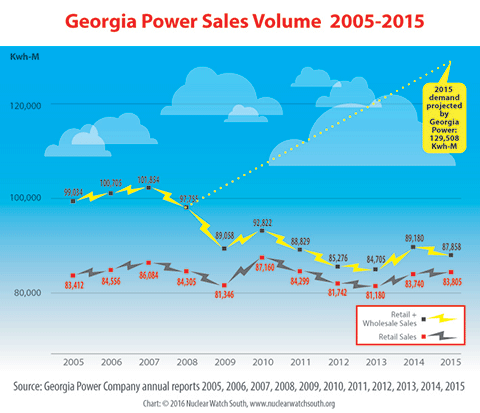
Line 6 shows Georgia Power's capacity utilization has declined from 71% to 65% for the same period. Georgia Power's capacity utilization remains well below the national average of 83% despite its improved annual average following the closure of 2,000Mw of coal plants in 2015.
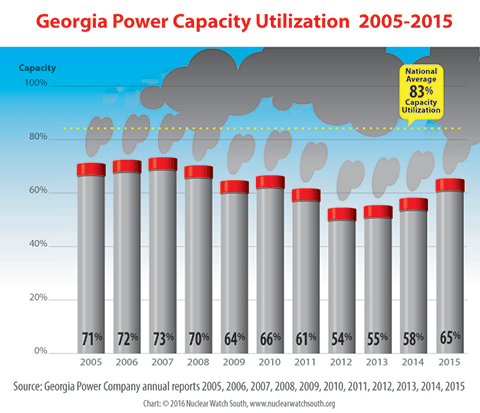
Vogtle 3 & 4 were certified based on Georgia Power forecasts of 4.1% annual growth which has not happened. Georgia Power's 2009 application for Vogtle 3 & 4 asserted new power generation would be required by 2016 and yet 2016 finds Georgia Power's sales to be essentially the same as in 2009.
The population growth predicted for Georgia has occurred, however — growing by 1,200,000 (12.5%) since 2005. Despite the growth in Georgia Power's customer base, electricity demand remains flat, mirroring national trends.
The data show that additional electrical power from Vogtle expansion is simply not needed.
Georgia Power is making record profits at the ratepayers’ expense
Line 2 of Exhibit #1 shows that Georgia Power's profits have increased almost 70% in the 10 year period 2005-2015. Again, for the same period, as shown in line 3, electricity sales fell more than 1% overall.
Georgia Power profits jumped by more than 20% for the years 2011-2015 coinciding with the Construction Work in Progress (CWIP) tariff, or, Nuclear Construction Cost Recovery (NCCR) collection.
Line 4 shows Georgia citizens, in addition to shouldering Vogtle construction costs, paid more for electricity, too, as the price for Georgia Power's residential customers rose by more than 16% between 2010 and 2015.
Cheaper to cancel Vogtle 3 & 4 than to complete
It would be cheaper to cancel, than to complete, construction of Plant Vogtle 3&4 given that the two additional reactors are not needed. Georgia Power testified in the current 14th VCM that Vogtle expansion is still only 31% finished. Georgia Power and its partners have spent almost $6 billion on Vogtle so far (and as has been well publicized, are $2 billion over budget and three years behind schedule). The cost of the completed project is roughly $18 billion at present. The cost to cancel the construction project would be far less than the $12 billion left to be spent which would save the public billions of dollars.
To repeat, Georgia Power is protected from financial risk from cancelling Vogtle expansion by the Georgia Code O.C.G.A. § 46-3A-6 which allows Georgia Power to recover the cost of shutting down the unneeded power plant construction.
With the $12 billion saved from stopping Plant Vogtle construction, more than twice the amount already sunk into unneeded nuclear capacity, Georgia Power can more rapidly deploy distributed renewable generating capacity as needed to transition away from coal and out-moded base load power. Constructing 21st-century clean, renewable energy, such as rooftop solar on new business and residential construction, will create thousands of jobs in smart grid transmission infrastructure, supply manufacturing and installation.
Conversely, if Georgia Power is allowed to continue constructing massive unneeded power supply at the expense of Georgia residential and small business electricity customers, those customers you are sworn to protect will be harmed by your failure to take action.
Nuclear Watch South’s arguments remain unrefuted
Neither Georgia Power, the Public Interest Advocacy staff nor the PSC have refuted Nuclear Watch South's basis for asserting that Vogtle 3&4 are not needed, namely the picture drawn by Georgia Power's own performance data.
The public seeks relief from the Public Service Commission
In an unregulated market, Georgia Power's profits would be linked to its performance. These data make it plain that the current set-up is enriching Georgia Power's investors by placing all financial risk in the troubled Vogtle 3 & 4 project on Georgia Power customers that it is your mission to protect.
Nuclear Watch South calls upon the PSC to exercise its regulatory power and authority to protect Georgia citizens from further exploitation as captive investors in Vogtle 3 & 4 and to move immediately to decertify Vogtle 3 & 4 construction.
Conclusions
• The Commission must allow Georgia Power to recover its expenses from the 14th VCM period as already ordered in the 8th VCM.
• The Georgia Public Service Commission's mission is to "exercise its authority and influence to ensure that consumers receive safe, reliable and reasonably priced ... electric service."
• The PSC has the authority to cancel Vogtle 3&4 reactors at any time if the certificated capacity is no longer needed.
• Georgia Power annual report data reveals that the company is overbuilt in a shrinking, shifting market and no longer needs the power from Vogtle 3&4.
• Georgia citizens are paying an unprecedented nuclear tariff for Vogtle construction which is resulting in unprecedented high profits for Georgia Power.
• The Georgia Public Service Commission should revoke certification for Vogtle 3 & 4 as authorized by Georgia O.C.G.A. § 46-3A-6 in order to protect Georgia electricity customers from further investment in unneeded resource capacity.
• The greatest benefit to the Georgia public since Vogtle 3 & 4 no longer meet the necessity test is for the Commission to immediately revoke certification and stop billing Georgia electric customers for Vogtle 3 & 4.
Nuclear Watch South Observes Chernobyl 30 with Georgia Power Performance Data Release
ATLANTA 4/26/16: In observance of the 30th anniversary of the Chernobyl nuclear disaster in Ukraine, Nuclear Watch South is releasing updated Georgia Power data which show Vogtle 3 & 4 are not needed and should be cancelled. A press conference and information release in front of Georgia Power headquarters will be held on Tuesday, April 26, 2016, at noon at the corner Baker/Highland and Piedmont in the shadow of Georgia Power headquarters.
Nuclear Watch South is unveiling updated charts based on Georgia Power’s latest annual report data which show that Georgia Power’s nuclear expansion at Vogtle still is not needed. The 2015 data show a deepening of negative 10-year trends: Georgia Power’s sales are down for another year and its capacity utilization is still well below the national average, despite the closure of 2,000 Mw of coal plants.
However, Georgia Power profits have swelled greatly, a five-year trend which followed a sudden uptick of more than 20% in 2011. The regulated monopoly’s profits have grown steadily during the years of Vogtle construction correlating with its collection of controversial CWIP tax, that is, Nuclear Construction Cost Recovery tariffs on Georgia Power residential and small customer bills.
“It is outrageous that Georgia Power has been running this Vogtle 3 & 4 racket for five years and getting away with it!” says Glenn Carroll, Nuclear Watch South’s coordinator. “These data show undeniably that Georgia Power doesn’t need the measly 6% increase in capacity that Vogtle 3 & 4 would provide IF Georgia Power can even build the reactors at all.
"Despite its notoriously poor performance at Vogtle 3 & 4, Georgia Power ‘earned’ a net profit margin of 15.3% ($1.26 billion) in 2015,” continues Ms. Carroll. "Given these factors, one wonders if Georgia Power has any real motivation to finish Vogtle. Heck, the money's so good, no wonder they are signing up to build two more!"
Construction delays and cost overruns at the Vogtle nuclear site which is still only 25% complete and was supposed to be on-line at the beginning of April have been well publicized. Georgia Power is currently seeking to clear its $7 billion Vogtle tab with the Public Service Commission (PSC). If the company succeeds in recovering the $7 billion it is putting through an ad hoc so-called prudency review, Georgia electricity customers and U.S. taxpayers will have borne the entire cost of the unfinished nuclear plants.
Georgia Power is also immersed in its 20-year Integrated Resource Plan which it is required to submit to the Georgia Public Service Commission every three years. Besides seeking to build two reactors on the endangered Chattahoochee River, the plan proposes shutting some coal plants and pursuing modest amnounts of solar and wind power. Georgia Power, like almost all U.S. monopoly, for-profit utilities, is studiously skeptical about roof-top solar, in which the distributed solar generation feeds into the existing grid.
Nuclear Watch South contends that Georgia Power's excess capacity could be a blessing in disguise, giving the regulated monopoly alot of room to redesign its power portfolio and update the state power grid from antique baseload to a distributed-renewable, computer-driven smart grid.
“Georgia Power should just stop Vogtle where it is and shut poisonous coal and nuclear plants, like the aged, leaking, Fukushima-style Hatch reactors near Vidalia, to reduce its excess capacity further,” says Carroll. “We applaud the company for seeking to build more renewable capacity in its Integrated Resource Plan down at the PSC. It has time on its side to transform to a 21st-century, distributed, clean power renewable grid.”
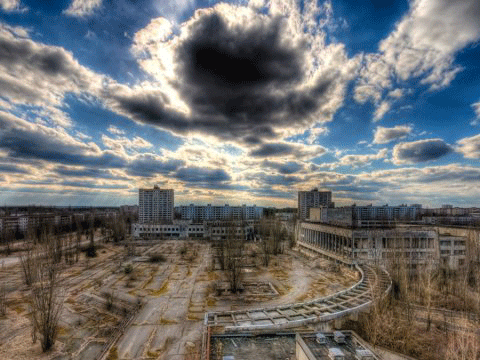 Photo: Timm Seuss 2014
All four reactors at Chernobyl are now shuttered. The evacuated “exclusion zone” is twice the size of Rhode Island and spans the Belarus/Ukraine border and was formerly known as the bread basket of the Soviet Union. Experts say the area will not be safe for habitation until 3,000 years from now. To give that timeframe some context: the entire history of Western civilization is only 3,000 years.
“Chernobyl changed my life. When I heard that a fissioning nuclear core had spewed its contents into the environment, I knew it was a game-changer,” says Carroll. “I became an activist. The atomic age was only 40 years old then. Now it is 70. Three more full-scale reactors have emptied their radioactive cores into the environment. It is time to stop the nuclear madness.
“The future of nuclear power is nuclear waste. We need to get on it!”
RESOURCES
Georgia Power Key Financial and Operating Data Chart 2005-2015
Georgia Power Profits 2005-2015
Georgia Power Capacity Utilization 2005-2015
Georgia Power Sales Volume 2005-2015
Hardened On-Site Storage for High-Level Radioactive Waste
Principles for Safeguarding Nuclear Waste at Reactors
Nuclear Watch South Releases Chart Showing Georgia Power's Profits from Vogtle Boondoggle
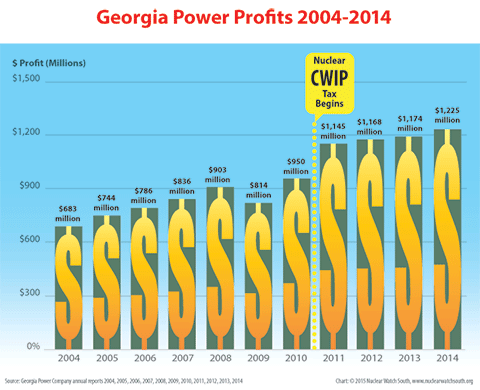
ATLANTA 12/7/15: Nuclear Watch South filed a demonstrative exhibit, GEORGIA POWER PROFITS 2004-2014 with the Georgia Public Service Commission (PSC) in support of direct testimony to be given on Thursday, December 10, 2015 at a public hearing on the 13th Vogtle Construction Monitoring and Review. The colorful chart illustrates a line in the previously submitted Updated Georgia Power Key Financial and Operating Data. Nuclear Watch South is presenting this data to the PSC to prove that Vogtle 3 & 4 are not needed and should be decertified.
The data chart is compiled from Georgia Power annual report data and shows that Georgia Power sales have been flat despite the company's forecast of 4.1% annual demand growth at the time of Vogtle 3 & 4 certification. The company's data also show that utilization of its existing capacity has been dropping and is well below industry average.
The latest chart starkly illustrates the correlation between a 20% jump in Georgia Power profits, establishing a new high water mark well above $1 billion, and the inception of Construction Work in Progress AKA Nuclear Construction Cost Recovery tariff in 2011. The chart supports the arguments made in Nuclear Watch South's direct testimony filed in November.
"We are hopeful that this picture grabs the attention of the Public Service Commission and inspires them to right the wrong being done to the citizens of Georgia," says Glenn Carroll, coordinator of Nuclear Watch South. "Georgia citizens are on the hook building an unneeded power source while Georgia Power is seeing unprecedented profit during an historic recession.
"We are at a turning point in history. Energy markets and utility business models are being transformed overnight. History demands bold vision and bold action and Georgia citizens are waiting to see if its Public Service Commissioners will heed the call."
READ NUCLEAR WATCH SOUTH'S BANNED TESTIMONY
Nuclear Watch South to PSC: Protect Georgia citizens from Georgia Power's excessive profits
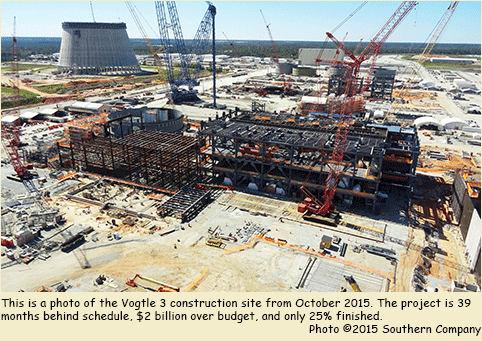
ATLANTA 11/20/15: Nuclear Watch South is releasing updated charts of Georgia Power’s SEC-filed data which show windfall company profits in the years that Vogtle 3 & 4 have been under construction. The information is key to testimony Nuclear Watch South filed with the Georgia Public Service Commission (PSC) in its 13th Semi-Annual Vogtle Construction Monitoring Review of the ongoing necessity and public convenience of Vogtle expansion.
Nuclear Watch South testimony is backed by Georgia Power’s annual report data which show Georgia Power increasing profits even as the company racks up sagging sales and is using less than 60% of its existing capacity.
“Georgia Power’s profits have risen an average of 6% annually even though their electricity sales have gone down. Meanwhile, our electric bills go up, up up, to pay for Plant Vogtle,” says Nuclear Watch South coordinator Glenn Carroll who is conducting the legal intervention representing Nuclear Watch South’s 1,000 Georgia members. “The numbers don’t lie. You can clearly see the surge in Georgia Power profits that occurred when they started collecting the nuclear construction cost recovery tariff on our bills.”
Georgia Power began collecting unprecedented Construction Work In Progress (CWIP) taxes on residential and small business customer bills in 2011 which produced a profit surge for the company over 20% and was also the first year in company history to top $1 billion in profits, a trend which continues through the most recent 2014 annual report.
CWIP is listed on Georgia Power customer bills as Nuclear Construction Cost Recovery (NCCR) thanks to a measure passed by the PSC which regulates Georgia Power's rates including allowing the investor-owned company to collect the nuclear construction tariff. The Georgia legislature passed the controversial Georgia Nuclear Energy Financing Act legalizing the nuclear tax in 2009.
Two reactors have been under construction at Vogtle in Burke County, Georgia, on the Savannah River near Augusta since March 2013. Georgia Power’s nuclear expansion project has already fallen 39 months behind schedule and it recently settled $2 billion in disputed cost overruns with its partners Westinghouse and CB&I.
“We call upon the PSC for bold vision and action to protect Georgia citizens from losing more money on the bad Vogtle bet,” says Ms. Carroll. “Georgia Power’s business plan is working out great for Georgia Power and its shareholders but it is adding up to a big goose egg of an investment for Georgians.
“We are living in a time of historic shifts in the energy field,” continues Carroll. “The success of solar and wind power is capturing the headlines but Georgia is stuck leading a Nuclear Renaissance to nowhere. History awaits the response of the Georgia Public Service Commissioners to the challenge presented by the Vogtle situation.
"It is time for the Commissioners to shut the Vogtle boondoggle down."
RESOURCES
DIRECT TESTIMONY OF GLENN CARROLL ON BEHALF OF
NUCLEAR WATCH SOUTH
UPDATED GEORGIA KEY FINANCIAL AND OPERATING DATA
GEORGIA POWER SALES VOLUME AND CAPACITY UTILIZATION CHARTS
NUCLEAR COST RECOVERY RIDER COLLECTIONS
FROM 2011 THROUGH 2016
Nuclear Watch South Denounces PSC Decision
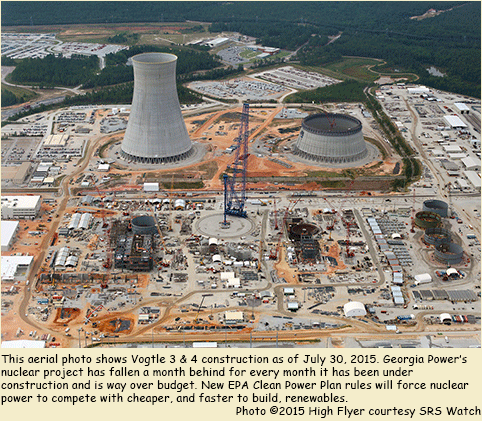
ATLANTA 8/18/15 — In the face of compelling data from 10 years of Georgia Power’s own annual reports showing that the company is overbuilt in a shrinking electricity market, the Georgia Public Service Commission’s (PSC) unquestioning allegiance to the company it is supposed to regulate was displayed in stark relief in its decision today. In a unanimous vote, the PSC not only granted Georgia Power’s requests, but it rejected every recommendation it received from the public and its own staff.
Unsurprisingly, the Commission voted to award Georgia Power $169 million rate recovery for its expenses on Vogtle 3 & 4 construction over the past six months. A 2013 stipulation entered into by some parties (but not Nuclear Watch South) provides for Georgia Power to recover without review its Vogtle construction expenses until it reaches a cap set by its certified capital cost. According to the stipulation, Georgia Power will have to seek recovery for any cost overruns in prudency review hearings following the Vogtle 3 reactor’s start-up, now optimistically projected by Georgia Power to occur in 2019. As long as the PSC allows the unneeded construction project which is fully funded by the rate paying and taxpaying public to continue, Georgia Power will continue to seek its entitlement every six months.
Nuclear Watch South was among the citizens groups which injected reasonable ideas into the 12th Vogtle Construction Monitoring Review over the past several months. Nuclear Watch South proposed that Vogtle 3 & 4 construction be cancelled or deferred until there is a market for the energy. Nuclear Watch South additionally argued for studies comparing the Vogtle project benefits to distributed solar and wind generation, an idea also put forth by consumer advocacy group Georgia Watch. The PSC Public Interest Advocacy Staff recommended that the PSC require such a study in the 2016 Integrated Resource Plan.
“By rejecting the staff’s recommendation in today’s vote, the PSC displays an unwholesome disregard for not only the electricity-buying public it is chartered to represent but for technological and marketplace realities coming to bear in Georgia,” says Glenn Carroll, Nuclear Watch South’s coordinator. “Vogtle construction continues to fall behind a month for every month it has been under construction even as solar and wind generation have become cheaper than nuclear. The Commissioners went out of their way today to display their slavish devotion to nuclear power, refusing to even entertain the question of whether there is a better and cheaper way for Georgia citizens to light and air condition their homes.”
Georgia Power fails to rebut Nuclear Watch South's challenge to Vogtle 3 & 4 necessity
Citizens renew call for Vogtle cancellation
ATLANTA (July 13, 2015) — On Friday afternoon, 7/10/15, Georgia Power Company requested a waiver from filing rebuttal testimony into the 12th Vogtle Construction Monitoring docket currently under review at the Georgia Public Service Commission (PSC). Georgia Power’s omission leaves Nuclear Watch South’s claim that Vogtle 3 & 4 are not needed unchallenged by the company.
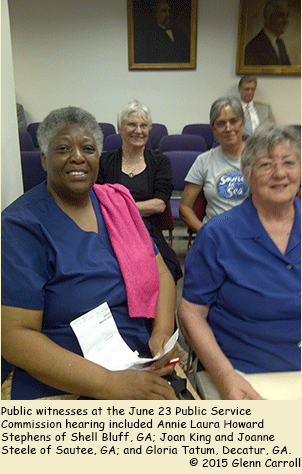 At a public hearing before the PSC on June 23, Nuclear Watch South presented testimony based on Georgia Power annual report data filed with the Securities Exchange Commission over the past 10 years which show clearly that electricity sales for the company have remained low despite rosy company forecasts for more than 4% annual growth in demand. The long-term low sales highlight Georgia Power’s excessive unused electric capacity and point to an obvious finding — additional nuclear generating capacity at Vogtle is not needed by Georgians, or customers from other states either.
“Georgia Power’s own SEC-filed data provides unassailable proof that Vogtle 3 & 4 are not needed,” says Nuclear Watch South Coordinator Glenn Carroll who served as the public interest group’s expert witness at the June 23 public hearing. “Georgia Power has not even attempted to re-spin the obvious conclusion that must be drawn from its sales and capacity utilization data — Vogtle 3 & 4 are simply not needed. Period.”
Nuclear Watch South also testified to the PSC about the Commission’s legal authority to cancel or modify Georgia Power’s certification to build two additional reactors at Vogtle which it issued in 2009.
“Georgia Power’s data illustrate how dramatically the electricity market has changed since the PSC’s decision to allow Georgia Power to construct Plant Vogtle,” says Ms. Carroll. “Fortunately, Georgia law provides for the PSC and Georgia Power to correct the course in light of new findings. Since Georgia Power is defaulting on its opportunity to justify continued construction of unneeded capacity, in light of the evidence, the PSC should move immediately to cancel construction and save further public money from being squandered at Vogtle.”
(See following article for charts and analysis.)
Since its inception, the Vogtle 3 & 4 project has been at the center of controversy. Georgia Power incited public outcry with heavy-handed legislative maneuvering to garner the notorious “Construction Work In Progress (CWIP)” tax now being charged at 10% on customer electric bills under the moniker “Nuclear Construction Cost Recovery.” At the same time, Georgia Power is borrowing billions of U.S. tax dollars in a no-interest loan from the U.S. Department of Energy which set off a national taxpayer resistance campaign. Now, only three years into construction, the reactors are already $2 billion over budget and more than three years behind schedule.
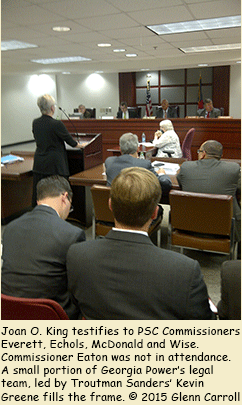 “The PSC is the only forum for Georgians to confront the rich and powerful Georgia Power monopoly,” Ms. Carroll observes. “A couple of times a year, ordinary citizens have an opportunity to address the PSC and Georgia Power about the breathtakingly expensive Vogtle 3 & 4 project. Now Georgia Power is effectively ducking confrontation with its captive public over the $18 billion boondoggle it has foisted upon us.”
In addition to testifying that it would be cheaper for Georgia electricity customers to cancel Plant Vogtle and absorb the loss than to finish unneeded electrical capacity, Nuclear Watch South called for a number of additional studies to update the basis by which Plant Vogtle’s cost-effectiveness is determined. Citing the Nuclear Regulatory Commission’s licensing policies and the historical limits to nuclear operating experience (45 years), Nuclear Watch South is demanding 40-year economic benefit analysis to supplement the 60-year economic basis currently employed. The group also called for the cost to cancel Vogtle 3 & 4 to be put on the table and for economic benefit comparisons to be drawn between nuclear and renewables instead of nuclear and fracked natural gas plants.
Contact: Glenn Carroll, Nuclear Watch South, 404-378-4263 | 404-432-8727 cell | e-mail
Nuclear Watch South to PSC: Vogtle Not Needed, Cancel Construction of Vogtle 3&4 Reactors
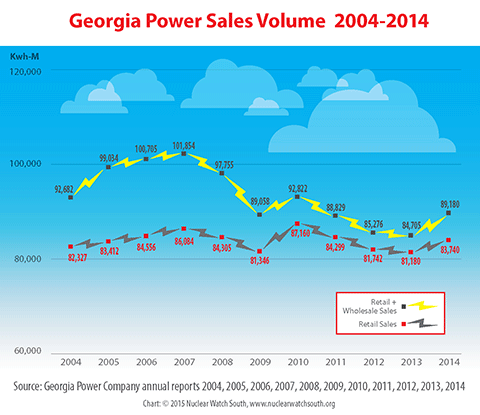
Chart illustrates that Georgia Power's electricity sales have a flat average growth rate over the past decade. The Georgia Public Service Commission issued certification for Vogtle 3 & 4 reactor construction based on Georgia Power forecasts of 4.1% annual growth. Georgia Power's capacity utilization is also depressed (see chart below) and Nuclear Watch South is calling for the PSC to decertify Vogtle 3 & 4. Data derived from Georgia Power annual reports by Georgia-based economist Steven C. Prenovitz.
ATLANTA June 11, 2015: Nuclear Watch South filed direct testimony in the semi-annual Vogtle construction monitoring docket at the PSC arguing to cancel construction of Plant Vogtle based on a chart of Georgia Power annual report data from the past 10 years showing that Vogtle’s power is not needed.
“Georgia Power forecast 4.1% annual increases in power demand when it convinced the PSC to certify a $14.6 billion expansion at Plant Vogtle,” says Nuclear Watch South’s coordinator Glenn Carroll who provided testimony on behalf of the Atlanta-based citizens' group. “Georgia Power’s own data shows in black-and-white that electricity sales have gone flat over the past 10 years. This mirrors what is happening all over the country, actually,” she adds.
Nuclear Watch South’s filing shows that Georgia Power sales in both retail and wholesale markets have remained flat over the 10-year period 2004–2014. The Georgia Power data also shows that the company’s annual average use of its existing generating portfolio has fallen from 72% to 58%. Nuclear Watch South's testimony cites Georgia code empowering the PSC to modify or revoke a certificated capacity resource if it is no longer needed. The law says that the Commission may initiate certificate modification, that is, mothball or cancel construction of unneeded power supply, upon its own initiative, at any time.
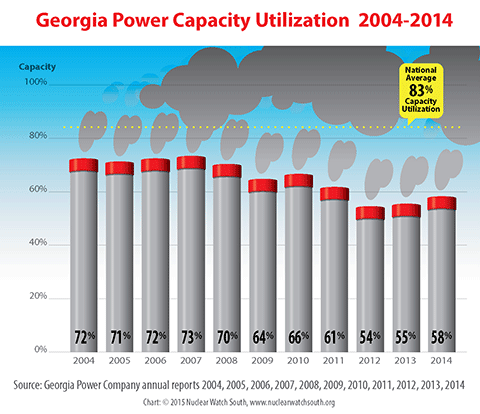
Georgia Power has spent $6 billion of public ratepayer and taxpayer dollars on Vogtle 3 & 4 despite a significant surplus of existing power supply. Georgia Power's capacity utilization has dropped from 72%, more than 10 points below the national average, to a weak 58% in 2014. Chart data compiled by Georgia economist Steven C. Prenovitz.
“Georgia Power testified last week that it is 24-25% finished with Plant Vogtle, yet it has already blown through $6 billion, one-third of its new $18 billion price tag,” Ms. Carroll says. “Nobody needs the power from Plant Vogtle and it would be cheaper for the investors — that is, Georgia Power’s customers being taxed for Vogtle construction on their power bills to pay — to just pay what it takes to be quit of this big, bad deal."
Georgia Power’s foray back into nuclear construction is one of only two projects to go forward from a rush of nuclear licensing which gave rise to “Nuclear Renaissance” talk a decade ago. Georgia Power’s decision was made amidst the availability of federal tax credits, cheap federal loans, and a Construction Work in Progress (CWIP) tax on Georgia Power electric bills to help pay construction costs.
As the “Nuclear Renaissance” withered, Georgia Power became isolated with a struggling supply chain and construction delays which it is blaming on Vogtle contractors. In the years since construction began, the group’s filing points out, not only has the nuclear industry begun struggling, but solar and wind power have become cheap and available. The group argues that updated studies establishing not only the cost to cancel construction at Plant Vogtle, but to compare the cost of finishing the project to seeking future power supply from distributed solar and wind generation are needed.
Recently Vogtle 3 & 4 have become notorious for falling prey to the persistent problems in building nuclear megaprojects. Vogtle’s difficulties have placed it three years behind schedule and $2 billion over budget.
Ms. Carroll says, “We are intervening in the Vogtle certification process to get the PSC’s attention upon important information that has been overlooked. Their decisions affect the millions of Georgia ratepayers that are captive to the monopoly which only they regulate. The five men on the Georgia Public Service Commission are literally the most powerful men on Earth when it comes to the multi-billion dollar Vogtle boondoggle going forward, or not."
NUCLEAR WATCH SOUTH DIRECT TESTIMONY
GEORGIA POWER KEY FINANCIAL AND OPERATING DATA 2004-2014
GEORGIA POWER SALES VOLUME 2004-2014
GEORGIA POWER CAPACITY UTILIZATION 2004-2014
DON'T NUKE THE CLIMATE
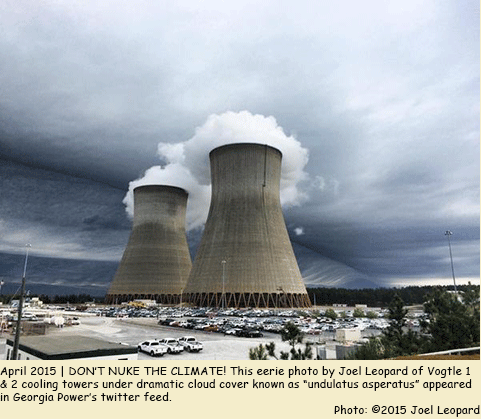
STAND UP FOR THE SAVANNAH RIVER
Nuclear Water Hog is Not Needed by Georgia Power,
EPD Must Deny Water Permit for Vogtle 3 & 4
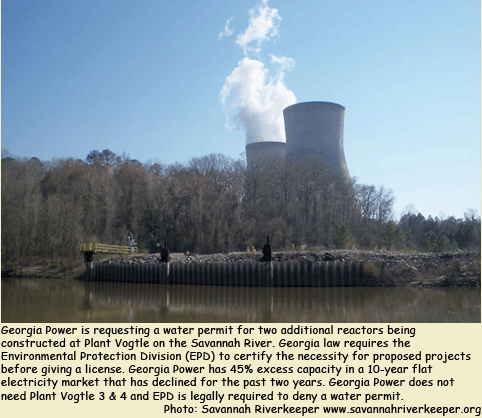
That sucking sound you hear? That's Georgia Power and its partners preparing to pull 74 million gallons of water a day out of the Savannah River to cool the nuclear reactors at Plant Vogtle ... in addition to the 127 million gallons per day the existing reactors are permitted to draw.
WAYNESBORO, 5/8/14: Georgia Environmental Protection Division (EPD) held a public hearing in response to requests from several parties, including Nuclear Watch South on Southern Nuclear's (division of Southern Company) massive water withdrawal permit request for Georgia Power reactors at Nuclear Plant Vogtle in Burke County, Georgia.
Concerned environmentalists converged from around the state with a long list of concerns about the negative impacts and gargantuan consumption Plant Vogtle would add to the already drought-stressed Savannah River.
Nuclear Watch South’s focus is on recent economic analysis showing that Georgia Power, chief owner and operator of the proposed additional Vogtle reactors, is significantly overbuilt with 45% unused capacity, exacerbated by its10-year flat electricity sales trend. Sales have steadily dropped in 2010-2013, the years the reactors have been under construction following Georgia Public Service Commission (PSC) approval for the project. The analysis is derived from Georgia Power annual report data submitted to the U.S. Securities and Exchange Commission under strict standards for accuracy and truthfulness.
According to Georgia Legal Code,* EPD is required to consider whether water withdrawals are “reasonably necessary” to meet the applicant's needs. Since Vogtle 3&4 are not needed, Georgia Power therefore does not need to use water from the Savannah River’s and EPD should deny the permit.
Glenn Carroll, coordinator of Georgia-based environmental organization Nuclear Watch South says, "Georgia Power’s own data show that sales have gone down, not up, for the 11-year period from 2002 to 2013. Georgia Power’s 4% annual growth forecast used to justify constructing two additional reactors at Vogtle has not materialized. Georgia Power is 45% overbuilt and in a protracted sales slump.
"Georgia Power does not need additional electric supply from Plant Vogtle and Georgia law requires EPD to deny the permit for projects that the applicant do not need," she concludes.
VIDEO: NUCLEAR WATCH SOUTH COORDINATOR GLENN CARROLL TESTIMONY AT GEORGIA EPD WATER HEARING
EPD is in an important position to balance factors which call into question continuing construction of the $17 billion dollar nuclear project which recently received $6.5 billion in unsecured loans from the U.S. Treasury via a 'loan guarantee' from the U.S. Department of Energy (DOE). The PSC approved Georgia Power’s project request based on Georgia Power forecasts of 4% annual sales growth without the benefit of recent analysis which reveals flat sales. The historic three-year decline occurred after the PSC's necessity certification of Vogtle in 2010. In 2009, the Georgia General Assembly passed the controversial nuclar CWIP tax (Construction Work in Progress) which Georgia Power charges on its bills as "Nuclear Construction Cost Recovery." The compliant PSC, captive ratepayers and CWIP were cited by DOE as securing the loan guarantee.
Carroll says, "EPD is empowered and obligated to protect the Savannah River from dire consequences of over-use. In denying the permit to a gargantuan, unnecessary project EPD will also save Georgia ratepayers and U.S. taxpayers from squandering billions of dollars more public funds on an unneeded nuclear water hog.”
EPD has given preliminary approval to Southern Nuclear’s request. There are myriad reasons that the application and review for the proposed water permit are deficient including the apparent failure to look comprehensively at Savannah River usage along its length or at the cumulative impacts over the decades-long operating life of the two additional reactors. A protracted, historic drought and multiple “water wars” with neighboring states make Georgia’s water use highly controversial. South Carolina’s Department of Health and Environmental Control has previously filed comments with EPD stressing lack of drought consideration and potential for depletion of necessary oxygen in the river water.
GROUPS REPRESENTED AT THE HEARING: Blue Ridge Environmental Defense League (BREDL) * Center for a Sustainable Coast * Concerned Citizens of Shell Bluff * Georgia Chapter of the Sierra Club * Georgia Women’s Action for New Directions (Georgia WAND) * Nuclear Watch South * Savannah Riverkeeper * Southern Alliance for Clean Energy * Southern Environmental Law Center * Emory’s Turner Environmental Law Clinic
* OCGA 12-5-31(g)
The division shall take into consideration the extent to which any withdrawals, diversions, or impoundments are reasonably necessary, in the judgment of the director, to meet the applicant's needs and shall grant a permit which shall meet those reasonable needs; provided, however, that the granting of such permit shall not have unreasonably adverse effects upon other water uses in the area, including but not limited to public use, farm use, and potential as well as present use; and provided, further, that the director shall grant a permit to any permit applicant who on July 1, 1977, has outstanding indebtedness in the form of revenue certificates or general obligation bonds which are being amortized through the sale of surface water, the permitted quantity of which shall be at least in an amount consistent with that quantity for which the revenue certificates or general obligation bonds were issued.
BACK TO STORY
TAKE ACTION!! SEND E-MAIL TO EPD: "NO WATER FOR VOGTLE!" >>
Federal Government Backs 6.5 Billion Dollars in Loans for Plant Vogtle
WAYNESBORO 2/20/14: U.S. Secretary of Energy Ernest Moniz came down to Georgia to sign off on giving 6.5 billion in taxpayer dollars to Southern Company, its subsidiary Georgia Power, and Oglethorpe Power to build two nuclear reactors at Plant Vogtle near Augusta.
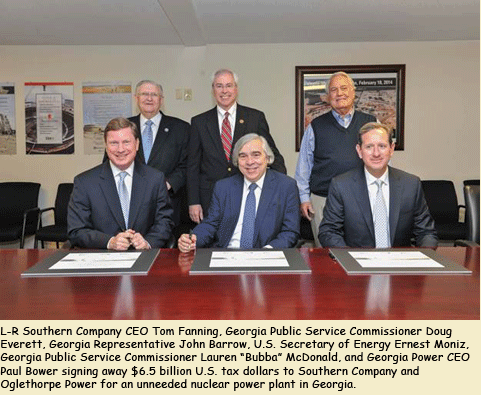
MEAG (Municipal Electric Association of Georgia), 22.7% owner of Vogtle is seeking 1.8 billion dollars in a separate loan guarantee and has a July closure deadline.
The terms of the loan are secret, but Southern Company has divulged to the media that it has put up collateral for the massive loan — namely, the unfinished Vogtle 3 and 4 reactors.
The relatively obscure loan guarantee program goes like this: Wall Street wouldn’t underwrite risky nuclear energy development, so erstwhile President George W. Bush persuaded U.S. Congress to pass a bill allowing the U.S. Department of Energy (DOE) to give “loan guarantees” to jump start construction of a new generation of nuclear reactors. These loan guarantees are direct payouts from the U.S. Treasury.
Troublingly, there is an historic 50 percent default rate in the loan guarantee program.
As the so-called “Nuclear Renaissance,” which was touted in the late Bush years, shriveled, Southern Company has become one of only two utilities in the country even attempting new reactors, and Southern Company became the sole candidate requesting loan guarantees.
Southern Company’s loan was first announced by President Barack Obama in 2010. Four years passed, in which Vogtle, less than half-finished, has gone 1.6 billion dollars over budget and 21 months behind schedule.
U.S. citizens have sent literally tens of thousands of letters and petitions to Obama and DOE demanding that the loan guarantees be withdrawn.
Southern Company has said repeatedly that it does not even need the loan guarantees.
The loan had been hung up for so long, reportedly, because Southern Company balked at the terms which amounted to an unbelievably low interest rate, an upfront “credit subsidy fee” of only 0.5-1.5 percent.
However, because the loan guarantee terms are secret, it is not known if Southern Company actually ended up paying anything at all to use taxpayer money.
We do know that DOE gave weight to Southern Company’s “captive ratepayers” and the Georgia Public Service Commission’s generously allowing electric customers to be taxed up front for Vogtle construction costs in a financing mechanism called Construction Work in Progress (CWIP).
Sara Barczak, high-risk energy choices program director for Southern Alliance for Clean Energy, calls it “corporate welfare for one of the largest power companies in the country.”
Recent analysis of Georgia Power annual report data shows that Georgia Power is not even using 46 percent of its electrical production capacity, has suffered flat sales for ten years years, and has posted declining sales the past three years.
This gives rise to real concern whether Southern Company, Georgia Power, Oglethorpe Power and MEAG can sell enough electricity to pay back their hefty loan from U.S. taxpayers.
“This loan guarantee is a sweetheart deal for the utilities building Plant Vogtle. Essentially, they’re gambling with every U.S. taxpayer’s dollars to unnecessarily expand one plant here in Georgia.” Becky Rafter, executive director of Georgia Women’s Action for New Directions, said.
VOGTLE NOT NEEDED: Nuclear Watch South tells PSC "Cheaper to cancel than complete"
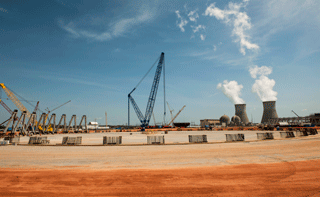 10/15/13 ATLANTA: Nuclear Watch South conducted its first-ever intervention before the Georgia Public Service Commission in opposition to the two-reactor expansion of Plant Vogtle. The cost of the reactors has rapidly risen from $14.3 billion to more than $16 billion as the schedule has slipped by 18 months, possibly more. An economist working with Nuclear Watch South found that the Vogtle expansion is not needed, the cost of Vogtle is too high, and it would be beneficial to Georgians to absorb the sunk costs and cancel the project.
Nuclear Watch South presented expert testimony by Steven C. Prenovitz in the 8th Vogtle Construction Monitoring Review (VCMR). This is the first time an intervening citizens’ group presented an expert witness in four years of semi-annual Vogtle expansion construction reviews which are typically dominated by witnesses from Georgia Power and the PSC’s Public Advocacy Staff (PIA).
Prenovitz, a trained economist, compiled and analyzed Georgia Power data from the company's annual reports for the years 2002-2012. In direct testimony, he asserted, “Georgia Power forecasts were for 4.1% growth in capacity, but in the key five-year period that coincides with the Vogtle expansion, capacity growth was 2.4%. Because Georgia Power’s capacity utilization factor declined from 73% to 54% in the same period, it is clear that expanding Vogtle’s capacity was not, and is not now needed.”
In the 8th VCMR public hearings, Georgia Power challenged Nuclear Watch South's position that Plant Vogtle expansion should be scuttled claiming cancellation was out of the scope of the proceeding, However Georgia O.C.G.A. § 46-3A-6 clearly charges the Public Service Commission with ongoing consideration of whether to cancel or continue construction of additional capacity and empowers the Commission to revoke or modify any project's certificate.
Prenovitz's Georgia Power Key Financial and Operating Data Chart constructed from 11 years of Georgia Power annual reports shows that Georgia Power’s sales are flat over a 10-year period while its capacity utilization has dropped from 71% to 54%. The data published by Georgia Power in its annual reports is required by the SEC. Prenovitz is the first expert to compare the data and produce an historical trend of Georgia Power's performance and market indicators.
Prenovitz also examined the costs of Plant Vogtle expansion into a chart entitled Georgia Power Vogtle Budget/Break Even Data and found the cost is escalating towards an amount that exceeds the total holdings of Georgia Power ($19 billion) while only promising to add 6% capacity overall. The conclusion is overwhelming that Vogtle’s expanded capacity is not needed by Georgia Power and not affordable by Georgia ratepayers.
Nuclear Watch South Coordinator Glenn Carroll commented, “Prenovitz's findings provide hard evidence, with Georgia Power's own data, that Plant Vogtle is too expensive by any measure, and unneeded. Georgia ratepayers are best served by the cancellation of additional reactors at Plant Vogtle.”
The issues that Georgia Power brought before the PSC were: 1) recovery of $209 million in construction costs in the last half of 2012; and 2) increase of $381 million in certified capital costs for the project. Nuclear Watch South challenged both requests, along with several other interveners, including Georgia Watch and the Southern Alliance for Clean Energy and multiple public witnesses. There was much discussion and cross-examination concerning a recent decision by the Mississippi PSC forcing Mississippi Power, another Southern Company subsiciary, to absorb $457 million in costs overruns at a coal plant under construction in Kemper, MS. To sidestep a similar decision in Georgia, Georgia Power and PSC Public Advocacy Staff entered into a stipulation which has the effect of deferring vigorous scrutiny of Vogtle expansion costs until Vogtle 3 may be completed far in the future. In a blatant affront to public process, the stipulation was approved by the PSC without proper public notice and outside of the published schedule for the proceeding. The PSC staff advised the Commissioners to adhere to the schedule but the Commission ignored its staff's advice and voted unanimously to adopt the stipulation on September 3, 2013, a fact which Nuclear Watch South learned in a newspaper report.
Nuclear Watch South was the only intervenor to filed proposed conclusions September 27, 2013, a vital part of the process in which the various parties may package information to help the Commission make its decision scheduled for October 15, 2013. In its brief, Nuclear Watch South called for Vogtle cancellation, and went on to make arguments against cost recovery, increased capital cost certification, and the stipulation.
“Citizen intervenors have done Georgia ratepayers a great service in reframing scrutiny of the exorbitant Vogtle project and proving it is not needed. With $4 billion to $6 billion still left to be spent, it is obvious it would be cheaper to abandon construction of two additional reactors," says Carroll.
"There has never been a clearer need for the PSC to exercise its authority to protect Georgia ratepayers,” she concluded.
NUCLEAR WATCH SOUTH POST-HEARING BRIEF AND PROPOSED ORDER
GEORGIA POWER KEY FINANCIAL AND OPERATING DATA CHART
GEORGIA POWER VOGTLE BUDGET / BREAK EVEN ANALYSIS
STEVEN C. PRENOVITZ TESTIMONY
GEORGIA PSC DOCKET #29849
OOPS! GA Power drops the Vogtle pressure vessel
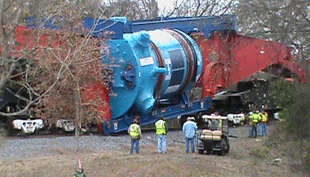 SAVANNAH 1/31/13: Days after Georgia Power circulated a news story bragging about the arrival of the 300-ton Korean-made reactor pressure vessel for Vogtle, an anonymous source leaked the news that Georgia Power had almost rolled the massive reactor pressure vessel into an alligator swamp en route from the Port of Savannah to the Vogtle construction site near Augusta, Georgia. The reactor vessel platform misaligned with the lauded Schnaebel rail car 1/4 mile from the Port of Savannah and the load has languished in the port railyard ever since.
The embarrassing news circulated and NUCLEAR WATCH SOUTH activists joined the Stop Plant Vogtle coalition to make sure the Public Service Commission knew about it with an impromptu performance of Georgia Power Choo Choo. Two weeks prior, dozens of citizens had jammed the PSC's public hearing room to protest cost overruns and CWIP taxes for the $14.2 billion (and mounting) nuclear construction project, unaware that Georgia Power was actively covering up their rail mishap.
Read more about it on Friends of the Earth's TOM CLEMENTS blog.
Nuclear Watch South joins legal opposition to license for two new reactors in Georgia
Groups contend that NRC failed to fully consider Fukushima lessons before issuing license to construct and operate two new nuclear reactors
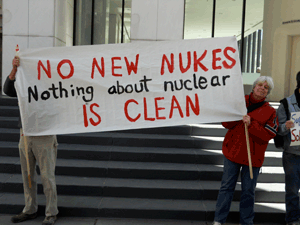 2/17/12: ATLANTA, GA The Nuclear Regulatory Commission (NRC) voted 4-1 on February 9, 2012, to issue the final license for two new reactors at the site of the currently operating Vogtle nuclear power plant in Georgia. NRC Chairman Gregory Jaczko cast the only dissenting vote, effectively agreeing with nine national, state and regional groups who will file a challenge in federal court.
TELL OBAMA "NO TAX $ $ $ FOR VOGTLE!"
A major legal challenge has been filed charging the NRC with violating federal law to issue the license without considering the important lessons of the catastrophic Fukushima accident in Japan and regarding the ways the Vogtle operation should be modified to protect public safety and the environment. The groups are asking federal judges to order the NRC to prepare a new environmental impact statement (EIS) for the proposed Vogtle reactors that explains how cooling systems for the reactors and spent fuel storage pools will be upgraded to protect against earthquakes, flooding and prolonged loss of electric power to the site. The EIS must also detail how emergency equipment and plans for the nuclear plant will be revised to account for accidents affecting multiple reactors on the Vogtle site, as happened at Fukushima.
As part of the action, the organizations are also challenging the validity of the Westinghouse-Toshiba AP1000 design, on which the new Vogtle reactors are based.
"It is terribly irresponsible of the NRC to rush this risky reactor project through even as Japan continues to grapple with the unstable condition of the wrecked Fukushima reactors," says Nuclear Watch South Coordinator Glenn Carroll. "There are many concerns with nuclear energy even beyond those raised by the Fukushima catastrophe. We hold out hope that Southern Company and Georgia Power may yet come to their senses to recognize the tangible successes of wind and solar power and decide to abandon dead-end, out-moded nuclear power.
"After all, Southern Company has not invested a dime of its own money so far, so they have nothing to lose and everything to gain if they choose to install solar panels on all that land they've already cleared," Carroll concludes.
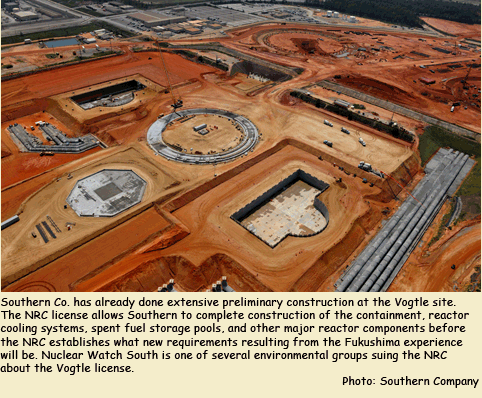
The organizations filed their lawsuit in the U.S. Court of Appeals for the District of Columbia Circuit. The nine organizations taking the legal action are: Friends of the Earth, the Southern Alliance for Clean Energy, Blue Ridge Environmental Defense League, Center for a Sustainable Coast, Citizens Allied for Safe Energy, Georgia Women’s Action for New Directions, North Carolina Waste Awareness and Reduction Network, Nuclear Information and Resource Service and Nuclear Watch South.
Although Southern Co. has already commenced extensive preliminary construction activities at the Vogtle site, the license would allow Southern to complete construction of the containment, reactor cooling systems, spent fuel storage pools, and other major reactor components.
The organizations charge that these major structures could change substantially if they are redesigned to take the lessons of the Fukushima accident into account, and therefore continued construction of the new Vogtle reactors could be wasting money and resources. And if the license is disapproved in the lawsuit or Fukushima-related retrofits make the project too expensive to finish, utility ratepayers in Georgia are likely to be stuck with the expense of a large and useless concrete mausoleum, similar to many other abandoned reactor projects across the U.S.
Separately, Southern Alliance for Clean Energy has sued the Department of Energy for failing to disclose key information about the terms of DOE’s $8.3 billion loan guarantee for the new Vogtle reactors, especially the risk posed to U.S. taxpayers should the estimated $14 billion project default. The organizations remain very concerned that utility customers and taxpayers have been forced to put more “skin in the game” than Southern Co. and its utility partners and shareholders. With prices of natural gas very low, even the CEO of Exelon has said publicly that he wouldn’t build a nuclear plant today.
MEDIA CONTACT: Glenn Carroll, Nuclear Watch South, 404-378-4263, atom.girl@mindspring.com
TAKE ACTION! >>
NUCLEAR WATCH SOUTH COORDINATOR ON DEMOCRACY NOW!
Anti-Nuclear Activists Mobilize to Oppose
Obama-Funded Construction of Georgia Nuke Plants
DEMOCRACY NOW! (2/24/10) The news in Vermont follows Obama’s announcement last week of $8.3 billion in loan guarantees for the construction of the first new nuclear power plants in the United States in close to three decades. The loan guarantees will help the Atlanta-based Southern Company build two more nuclear reactors in Burke County, Georgia, near the city of Augusta. We speak to Nuclear Watch South coordinator Glenn Carroll, who has been leading efforts against the construction of the new plants.
ALSO ON DEMOCRACY NOW! Nuclear engineer Arnie Gundersen speaks about the historic vote to shut Vermont Yankee and the cover-up of an underground plume of radioactive tritium heading for the Connecticut River. Arnie's stunning and informative interview with Amy Goodman begins at the 10:30 mark.
TAKE ACTION! >>
“RADIOACTIVE RIP-OFF”
Tax-Funded Nuclear Bailout for Southern Company
OBAMA SAYS $8.3 BILLION IN NUCLEAR LOAN GUARANTEES
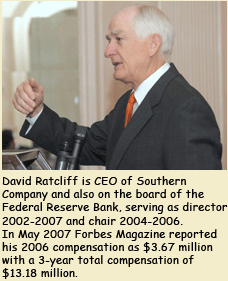 ATLANTA (2/16/10) ~ The “Nuclear Renaissance” promoted by Bush’s last administration reached a controversial milestone today with President Obama and Energy Secretary Chu’s much-anticipated announcement that $8.3 billion in tax-funded loan guarantees will be granted to Southern Company to construct two new reactors in Georgia. The reactors are proposed in addition to the two reactors already at Plant Vogtle in Burke County on the Savannah River near Augusta. Southern Company has not said that it will take the deal. Loan guarantee details were worked out in closed-door meetings between the U.S. Department of Energy and privately-owned electricity giant Southern Company.
Glenn Carroll, coordinator of Georgia-based environmental group Nuclear Watch South expressed dismay about the nuclear loan guarantees announcement. “It is a giant radioactive rip-off for Georgians and the U.S. taxpayers to promise our money for nuclear reactors. Radioactive risk and radioactive waste are the only promises that nukes can be counted on to keep.”
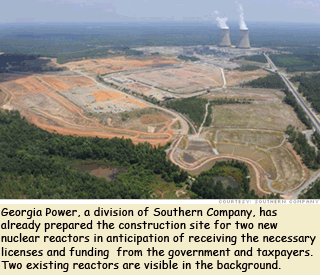 Despite Obama's announcement, Southern Company will not qualify to receive the tax-funded loans until it obtains a license to build the reactors from the U.S. Nuclear Regulatory Commission (NRC). The license is opposed by several environmental groups. Southern Company has resisted using union labor, a possible loan guarantee condition which may drive up already high estimates for the reactors. The loan guarantees are also contingent upon NRC approval for the Vogtle reactor design. A generic license for the Westinghouse “AP 1000” reactor design which Southern Company proposes for the Vogtle site is being questioned by the NRC over safety concerns. The Westinghouse design has downgraded the typical robust concrete “containment building” to a much less substantial “shield building” made from stacked concrete blocks.
NO POISON POWER NEEDED HERE!
It will be a shame if Southern Company misses out on the green energy revolution because it is blinded by promises of easy money to pursue antiquated nuclear energy.
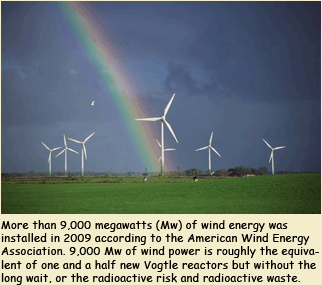 The new nuclear reactors are part of a federal energy legislation package which attempts to address climate change. There are hopeful trends which may yet offset the need for new reactors which take many years to license and construct. Energy Department figures from the third quarter 2009 saw renewables surpass nuclear’s contribution to the total energy picture for the first time. The American Wind Energy Association reports that close to 10,000 Mw of new wind power joined the grid in 2009 — that's ALOT of clean power especially when you consider it would take the better part of a decade to install new nuclear energy. In addition, U.S. energy consumption habits have finally begun to shift and Southern Company predictions for energy need are not likely to materialize as it, too, has reported a downturn in electric sales for the past two years (the first time ever that sales have dropped for two years in a row).
“Loan guarantees for nuclear reactors are short-sighted,” says Ms. Carroll. “We predict that while we are waiting for nuclear energy to get itself ready, forward-thinking efficiency measures and small-scale installations of wind and solar which are joining the grid every day will transform the energy landscape and offset the need for more radioactive poison power. It will be a shame if Southern Company misses out on the green energy revolution because it is blinded by promises of easy money to pursue antiquated nuclear energy.”
TAKE ACTION! >>
"To the village square
we must carry the facts
of atomic energy.
From there must come America's voice."
ALBERT EINSTEIN

~~~~~~
~~~~~~
GROUPS WANT FEDS TO PROBE PSC, GEORGIA POWER AFTER RATE INCREASE
by T.A. DeFeo
Washington Examiner
12/23/23
~~~~~~
PETITION TO HOLD IN ABEYANCE
10/27/23
AJC: GROUPS WANT VOGTLE COST HEARINGS HALTED UNTIL GEORGIA PSC ELECTIONS ARE HELD
by Drew Kann
11/2/23
WABE: COURT DECISION EXPECTED SOON ON GEORGIA PUBLIC SERVICE COMMISSION ELECTION
Mary Landers
11/2/23
DELAYED ELECTIONS COULD IMPACT YOUR GEORGIA POWER BILL | HERE'S WHY
11 Alive News
11/3/23
~~~~~~
UPDATED KEY
GEORGIA POWER FINANCIAL AND OPERATING DATA
2012-2022
by Steven Prenovitz May 2023
GEORGIA POWER PROFITS
2008-2022
GEORGIA POWER
SALES VOLUME
2008-2022
GEORGIA POWER CAPACITY UTILIZATION
2008-2022
~~~~~~
AN ANSWER FOR GEORGIA POWER
by Jay Bookman
Atlanta Journal/Constitution
11/13/17
AS GEORGIA REGULATORS PONDER VOGTLE'S FUTURE, MORE REVELATIONS EMERGE BOUT ITS DOOMED TWIN IN SOUTH CAROLINA
by Tom Baxter
Saporta Report
11/13/17
CEO OF GEORGIA POWER SKIPS THE WHOLE APOLOGY THING
by Matt Kempner
Atlanta Journal-Constitution
11/8/17
TIME TO DECIDE IF YOU PAY MORE FOR GEORGIA'S NUCLEAR DEBACLE
by Matt Kempner
Atlanta Journal-Constitution
11/3/17
GEORGIA POWER VS. THE LAW OF HOLES
by Lyle Harris
Saporta Report
10/16/17
GEORGIA POWER, SOUTHERN CO. HAVE NUKED THEIR CREDIBILITY
by Jay Bookman
Atlanta Journal-Constitution
8/8/17
GEORGIA POWER'S NUCLEAR TOWER TEETERS; EMCs "CONCERNED"
by Matt Kempner
Atlanta Journal-Constitution
8/6/17
~~~~~~
VOGTLE BIG BUCK$ LOTTO

READ THE BLOG @
NO NUKES Y'ALL TIMES
by Glenn Carroll
5/17/17
~~~~~~
UPDATED
GEORGIA POWER
KEY FINANCIAL AND OPERATING DATA
April 2017
~~~~~~
RATEPAYERS PUSH VOGTLE CANCELLATION AT PSC NUCLEAR HEARING, VCM 16
by Gloria Tatum
Atlanta Progressive News
5/15/17
EIA PREDICTS NUCLEAR SHARE OF U.S. GENERATION TO FALL NEARLY 50% BY 2050
by Abby Harvey
POWER Magazine
5/12/17
NEW REPORT SHOWS SOLAR, ENERGY EFFICIENCY OUTCOMPETE NUCLEAR IN MEETING GEORGIA’S ENERGY NEEDS
Southern Environmental Law Center
5/12/17
PLANT VOGTLE FUTURE, PUBLIC SERVICE COMMISSION AND CRITICS WEIGH IN
By JoAnn Merrigan
WSAV3 NBC Savannah
5/12/17
GEORGIA POWER REACHES TENTATIVE DEAL TO TAKE OVER PLANT VOGTLE WORK
by Russell Graham
Atlanta Journal-Constitution
5/12/17
"A CLOSER LOOK"
@ PLANT VOGTLE
(story starts at 27:00)
NPR
5/11/17
SOUTHERN CO: ‘WEEKS’ BEFORE WE’LL KNOW COST OF PLANT VOGTLE EXPANSION
by Russell Grantham
Atlanta-Journal Constitution
5/11/17
VOGTLE DISCUSSION HEATS UP AT GEORGIA PSC HEARING
by Thomas Gardiner
Augusta Chronicle
5/11/17
GEORGIA POWER WEIGHING FUTURE OF PLANT VOGTLE
by Molly Samuel
All Things Considered WABE90.1
5/11/17
GA. POWER AT CROSSROADS ON PLANT VOGTLE PROJECT
by Russell Grantham
Atlanta Journal-Constitution
5/10/17
WAITING FOR A VERDICT ON VOGTLE
by Dusty Nix
Columbus Ledger-Enquirer
5/11/17
~~~~~~
SIGN PETITION
Protect consumers from nuclear boondoggles in Georgia & South Carolina
~~~~~~
GEORGIA POWER PROFITS OFF PLANT VOGTLE CONSTRUCTION DESPITE COST OVERRUNS, DELAYS, AND CONTRACTOR BANKRUPTCY
by Anne Maxwell
News Channel 6 ABC
5/8/17
ACTIVISTS SEEK EMERGENCY PSC HEARING TO RECONSIDER VOGTLE REACTORS 3,4
by Gloria Tatum
Atlanta Progressive News
4/24/17
TROUBLED NUCLEAR PLANT COSTS RISING FOR SAVANNAH RESIDENTS
by Mary Landers
Savannah Morning News
4/8/17
THE HIGH COST OF IGNORING RISK
by Ryan Alexander
U.S. News & World Report
4/6/17
VOGTLE’S NUCLEAR EXPANSION IN QUESTION AFTER WESTINGHOUSE BANKRUPTCY FILING
by Gloria Tatum
Atlanta Progressive News
4/5/17
HOW AN AMERICAN TECH ICON BET ON NUCLEAR — AND LOST
by Chris Martin and Chris Cooper
Bloomberg
3/29/17
SOUTHERN CEO FLEW TO TOKYO TO LOOK TOSHIBA CEO IN THE EYE
by Chris Martin and
Jim Polson
Bloomberg
3/29/17
TIME FOR A NUCLEAR APOLOGY FROM YOUR POWER COMPANY
by Matt Kempner
Atlanta Journal-Constitution
3/29/17
GA. POWER SEEKS ‘BEST PATH FORWARD’ AT VOGTLE
by Russell Grantham
Atlanta Journal-Constitution
3/29/17
WESTINGHOUSE FILES FOR BANKRUPTCY, IN BLOW TO NUCLEAR POWER
by Diane Cardwell and Jonathan Soble
New York Times
3/29/17
WESTINGHOUSE FILES FOR BANKRUPTCY, OMINOUS CLOUD HOVERS OVER VOGTLE
by Tom Crawford
Georgia Report
3/29/17
WESTINGHOUSE FILES FOR BANKRUPTCY
by Thomas Gardiner
Augusta Chronicle
3/29/17
NUCLEAR POWER SUFFERS MAJOR BLOW WITH WESTINGHOUSE BANKRUPTCY
by Nika Knight
Common Dreams
3/29/17
CONTRACTOR BANKRUPTCY COULD BE TROUBLE FOR GEORGIA POWER
by Molly Samuel
WABE 90.1
3/24/17
WESTINGHOUSE BANKRUPTCY MAY LIMIT TOSHIBA'S LOOMING LOSSES
by Pavel Alpeyev and Chris Martin
Bloomberg
3/22/17
~~~~~~
THANKS TO PSC, UTILITY KEEPS ITS STICKY FINGERS IN PUBLIC'S POCKETS
by Glenn Carroll
Gainesville Times
12/17/16
HAPPY HOLIDAYS FROM GEORGIA POWER
PSC could decide to give you a lump of uranium (and a higher electric bill)
by Sara Barczak
Creative Loafing
12/13/16
THAT'S NOT A CANDY CANE GEORGIA POWER'S HANDING US
by Matt Kempner
Atlanta Journal-Constitution
12/1/16
~~~~~~~
NUCLEAR WATCH SOUTH PROPOSED ORDER
14th Vogtle Construction Monitoring Review
8/5/16
~~~~~~~
DIRECT TESTIMONY OF
GLENN CARROLL
ON BEHALF OF
NUCLEAR WATCH SOUTH
VCMR14
6/14/16
UPDATED
GEORGIA POWER
KEY FINANCIAL AND OPERATING DATA
April 2016
GEORGIA POWER
PROFITS
2005-2015
April 2016
GEORGIA POWER
SALES VOLUME
2005-2015
April 2016
GEORGIA POWER
CAPACITY UTILIZATION
2005-2015
April 2016
~~~~~~~
RUINED CHERNOBYL NUCLEAR PLANT WILL REMAIN A THREAT FOR 3,000 YEARS
by Matthew Schofield
McClatchyDC
4/24/16
~~~~~~~
NUCLEAR WATCH SOUTH
PROPOSED ORDER
VCMR 13
1/29/16
~~~~~~~
GEORGIANS, GET READY FOR A POWER BILL STICKER SHOCK
by Tom Crawford
Gainesville Times
12/16/15
PSC MEMBERS REST EYES, BAN CRITICAL TESTIMONY DURING VOGTLE HEARING
by Gloria Tatum
Atlanta Progressive News
12/14/15
PLANT VOGTLE WORK GETTING FURTHER BEHIND, EXPERTS TESTIFY
by Walter C. Jones
Augusta Chronicle
12/10/15
MORE DELAYS FOR PLANT VOGTLE
by Walter C. Jones
Athens Banner-Herald
12/10/15
MORE DELAYS FOR PLANT VOGTLE
by Walter C. Jones
Savannah Morning News
12/11/15
VOGTLE NUKES COULD ENCOUNTER MORE DELAYS MONITORS SAY
by Tom Crawford
Georgia Report
12/10/15
~~~~~~~
DIRECT TESTIMONY OF
GLENN CARROLL
ON BEHALF OF
NUCLEAR WATCH
SOUTH
11/20/15
NUCLEAR WATCH SOUTH REBUTTAL TO GEORGIA POWER MOTION TO STRIKE TESTIMONY
12/8/15
~~~~~~~
ANTI-NUCLEAR GROUP USES FREE MARKET ARGUMENTS AGAINST PLANT VOGTLE
by Jim Clarkson
MasterResource
12/8/15
GA. POWER ASKS PSC TO MUZZLE ONE OF ITS NUCLEAR CRITICS
by Tom Crawford
Georgia Report
12/8/15
VOGTLE SETTLEMENT COULD COST UTILITY CUSTOMERS
by Russell Grantham
Atlanta Journal-Constitution
11/7/15
PSC CRACKS DOWN ON CRITICS OF VOGTLE NUCLEAR PROJECT
by Tom Crawford
Georgia Report
11/3/15
~~~~~~~
PSC APPROVES LATEST SPENDING REPORT ON VOGTLE NUKES
by Tom Crawford
Georgia Report
8/18/15
~~~~~~~
NUCLEAR WATCH SOUTH BRIEF
8/7/15
DIRECT TESTIMONY OF
GLENN CARROLL
ON BEHALF OF
NUCLEAR WATCH SOUTH
6/10/15
DIRECT TESTIMONY OF WILLIAM R. JACOBS, JR., PH.D. ON BEHALF OF THE CITIZENS OF THE STATE OF FLORIDA
6/22/15
GEORGIA POWER RESERVE MARGINS
by Jeffry Pollock
for Georgia Industrial Group and Georgia Association of Manufacturers
10/18/13
SOLAR POWER: BEWARE UNNECESSARY COST TO GEORGIANS
by Stan Wise
Atlanta Business Chronicle
7/5/13
COUNTERPOINT: STAN WISE' BLISTERING CRITICISM OF PSC'S SOLAR DECISION
by Jim Galloway
Atlanta Journal-Constitution
7/11/13
~~~~~~~
HOT VOGTLE SCOOP
VOGTLE: AT $65 BILLION AND COUNTING, IT'S A CASE STUDY OF NUCLEAR POWER'S STAGGERINGLY AWFUL ECONOMICS
by Michael Mariotte
GreenWorld
8/2/15
VOGTLE NUCLEAR EXPANSION TOTAL COST IS 65 BILLION DOLLARS, FORMER COMMISSIONER SAYS
by Gloria Tatum
Atlanta Progressive News
8/1/15
GEORGIA POWER MUM ON CLAIM THAT NUCLEAR EXPANSION UNNEEDED
by Gloria Tatum
Atlanta Progressive News
7/30/15
HEARING IN VOGTLE REVIEW PROVIDES NEW INFORMATION ON PROJECT'S COST
by Bobby Baker
Clean Energy Blog
7/1/15
ACTIVISTS ASK REGULATORS TO RECONSIDER NUCLEAR POWER UNITS
by Molly Samuel
WABE | Atlanta's NPR
6/23/15
MORE CONSTRUCTION DELAYS PUT FOCUS ON VOGTLE PROJECT'S ECONOMICS
by Scott Judy
Engineering News Record
6/24/15
~~~~~~~
DRAFT EPD PERMIT FOR VOGTLE 3 & 4
TALKING POINTS
~~~~~~~
SPEAKING UP FOR SAVANNAH RIVER
VOGTLE WATER WITHDRAWAL PLAN DRAWS SUPPORT, OPPOSITION
by Meg Mirshak
Augusta Chronicle
5/8/2014
NUKES THIRST FOR SAVANNAH RIVER WATER
by Mary Landers
Savannah Now
5/7/14
DIRTY DOZEN REPORT
Georgia Water Coalition
~~~
5/8/14
CITIZEN TESTIMONY
EPD HEARING ON VOGTLE WATER PERMIT
ON YOUTUBE
SAM BOOHER
Augusta, Georgia
CENTER FOR A SUSTAINABLE COAST
Steve Willis
COASTAL SIERRA CLUB
Karen Grainey
GEORGIA SIERRA CLUB
Colleen Kiernan
Bernice Johnson-Howard
Burke County, Georgia
NUCLEAR WATCH SOUTH
Glenn Carroll
SOUTHERN ALLIANCE FOR CLEAN ENERGY
Sara Barczak
SAVANNAH RIVERKEEPER
Tonya Bonitatibus
~~~~~~
HOT REPORTS
WORLD NUCLEAR INDUSTRY STATUS REPORT 2013
by Mycle Schneider and Antony Froggatt
July 2013
RENAISSANCE IN REVERSE
by Dr. Mark Cooper
July 2013
~~~~~~
ACTIVISTS SEE U.S. NUCLEAR INDUSTRY BEGINNING TO CRUMBLE
by Matthew C. Cardinale
IPS News Agency
~~~~~~
MORE ON
LOAN GUARANTEES
FOREIGN COMPANIES TO BENEFIT FROM NUCLEAR LOAN GUARANTEES
Robert Alvarez
NUCLEAR NOT THE ANSWER
Dr. Arjun Makhijani
"Obama Trying to
Fast Track Nuke Plants, Critics Say"
ABC News
"Obama's Nuclear Boondoggle"
Mother Jones
NUCLEAR POWER PLANT LOAN GUARANTEES:
An Unacceptable Risk
Mary Byrd Davis, PhD
FIVE REASONS
NOT TO INVEST IN NUCLEAR POWER
Robert Alvarez
~~~~~~
KNOW ABOUT IT
Breakthrough study by IEER proves we can get off coal, oil and nuclear by 2040
FREE DOWNLOAD
READ THE SUMMARY
VISIT THE WEBSITE
~~~~~~
RADIOACTIVE
TEA PARTY!
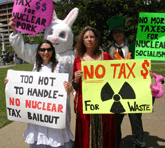
ALICE is none other than Nuclear Watch South's Leslie Minerd who is joined by White Rabbit Tom Clements (Friends of the Earth), Red Queen and SC Sierra Club Chair Susan Corbett, and Tea Party Host Extraordinaire, the Mad Hatter, Tim Liszewski of Carolina Peace Resource Center. Alice and Crew crashed the 2008 Tea Party rally in Columbia, SC, and put tax-funded nuclear loan guarantees in front of the Tea Partiers and the local media.