FUKUSHIMA NEWS
~ ~ ~ ~ ~ ~ ~
Help the
NO NUKES Y'ALL
campaign
y'all
Nuclear Watch South is a 501(c)(3) tax-deductible charitable organization.
{ thanks }
PayPal
It's your
safe and secure
way to donate on-line
 |
~ ~ ~ ~ ~ ~ ~

~ ~ ~ ~ ~ ~ ~
NEW NUKES for Georgia???
NO THANKS!!!
CLICK HERE
~ ~ ~ ~ ~ ~ ~

CLICK HERE FOR THE
WHOLE UGLY STORY
~
Follow the action at
NUCLEARBAILOUT.org
Educating and activating the grassroots to create a
nuclear-free future
~
PO Box 8574
Atlanta, GA 31106
404-378-4263
Cell 404-432-8727
info@nonukesyall.org
NO NUKES Y'ALL!
RADIOACTIVE WASTE
STOP FUKUSHIMA FREEWAYS
Atlanta and Georgia Targets for Radioactive Shipments
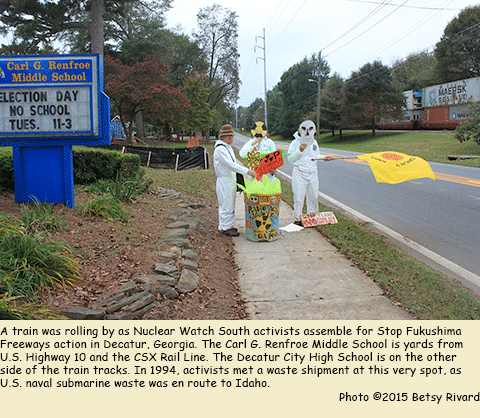
DECATUR 10/29/15 — Over 1,500 intensely radioactive nuclear waste shipments would cross through Georgia, if plans for the country’s first, and scientifically indefensible, nuclear waste repository in Nevada continue to move forward. Today, Nuclear Watch South joins Nuclear Information & Resource Service and dozens of citizens’ environmental and clean energy groups across the country in releasing maps of the likely routes radioactive shipments would use. The groups want residents to weigh in with Congress and decision makers about the dangers of radioactive transport through communities.
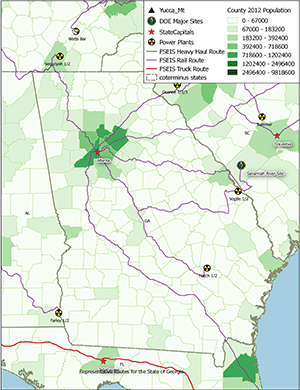
Nuclear Watch South released maps of likely Georgia and U.S. tran sportation routes in front of Renfroe Middle School in Decatur. Georgia, to drive home the point that the middle school is located on U.S. 10 and across the highway from a major CSX rail line. Decatur High School is situated on the other side of the railroad tracks.
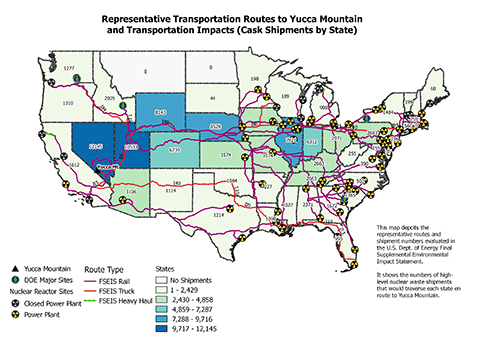
Decatur and DeKalb, along with the rest of Georgia, are especially vulnerable to exposure to the radioactive shipments. DeKalb County is bisected by I-85, I-20 and I-285 as well as numerous rail lines and federal and state highways.
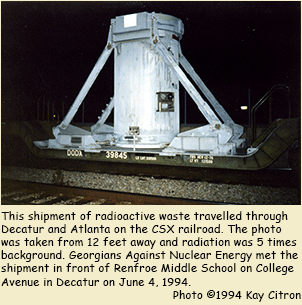 In 1996 the City of Decatur passed a resolution to declare the city a Nuclear Free Zone. In 1994, Nuclear Watch South (then called GANE - Georgians Against Nuclear Energy) tracked a shipment of spent nuclear fuel through Decatur and Atlanta. The shipment which was five times background from 12 feet away, stood by the Edward Pie Company in the Lake Claire community for several hours on June 4, 1994.
According to the map, highly radioactive waste fuel from nuclear power reactors in surrounding states would travel through Georgia and Atlanta on railroad tracks next to MARTA rail trains, including passing though Atlanta. Each shipment contains several times more radioactive material than the Hiroshima bomb blast released, with 20 to 50 tons of irradiated fuel assemblies in each canister. Department of Energy studies completed in the 1990s confirmed that accidents in transporting the waste to Yucca Mountain in Nevada would be a certainty, due to the large number of shipments that would be required. The shipments would also be vulnerable to attack or sabotage along the hundreds or thousands of miles that each cask would travel.
 “Georgia is not ready for mass transportation of nuclear waste — we can barely handle rush hour and regularly become crippled in severe weather,” says Glenn Carroll, coordinator of Atlanta-based Nuclear Watch South. “First responders are not trained or equipped for high-level radioactive waste accidents and a shipping campaign of this magnitude is unprecedented. An accident involving tons of nuclear waste in metropolitan Atlanta could force thousands of people to evacuate their homes, schools, and businesses and radioactively-contaminate dozens of square miles.
“Congress should stop kicking the radioactive waste canister down the road as it has done for the entire 70 years of the Atomic Age,” continues Ms. Carroll. “We need real isolation of nuclear waste, and short-term stabilization of the waste mounting up in vulnerable spent fuel pools at Georgia Power's nuclear reactors, all of which are on the banks of major Georgia rivers. While Congress and the nuclear industry get their act together, the waste can, and should, be stored more securely where it is now, without putting it on our roads, rails and waterways, traveling through our communities,” concluded Carroll.
While the Nuclear Waste Policy Act mandates a geologic repository for the highly radioactive commercial spent nuclear fuel, some in Congress are calling for large-scale nuclear waste transport which would occur if, as some in Congress advocate, if a "centralized interim storage" site for high-level radioactive waste were created. In that case, the waste would either have to move twice (once to the interim site, and then to a permanent repository), doubling the transportation and handling risks or the "interim" site would likely become a de facto permanent waste dump without the necessary scientific characterization to serve for long-term storage.
DOWNLOAD GEORGIA MAP
DOWNLOAD U.S. MAP
Hardened On-Site Storage Nuclear Waste Management Plan
Principles for Safeguarding Nuclear Waste at Reactors
Nuclear Waste Policy Made Simple by Union of Concerned Scientists

VISIT UNION OF CONCERNED SCIENTISTS FOR MORE INFO
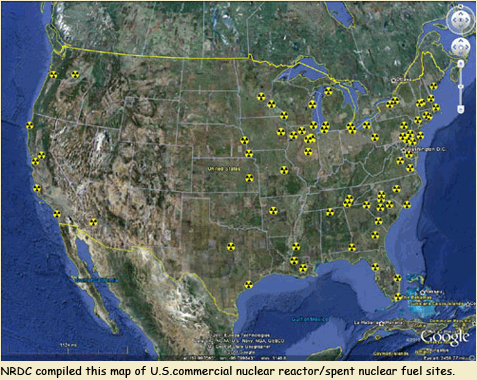
Map of United States Radioactive Waste Factories
THE PERSISTENCE OF RADIATION
The Nuclear Waste Legacy of Maine Yankee
Comments on the Desirability of Nuclear Power as a Component of our Energy Policy
by Maria Holt and Betty King
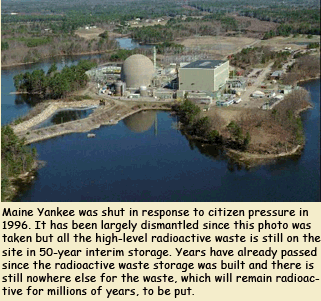 We are engaged in putting together the story of how a coalition of
fairly ordinary people, for the most part without impressive
credentials or connections in high places in finance or government,
were able to mount an effort that ultimately resulted in closing down
a nuclear power plant.
We are engaged in putting together the story of how a coalition of
fairly ordinary people, for the most part without impressive
credentials or connections in high places in finance or government,
were able to mount an effort that ultimately resulted in closing down
a nuclear power plant.
The story leads through doubts, dilemmas and despairs, fears and fantasies toward the building of a solid base of information and a powerful citizens’ referendum, which led to a series of investigations by the Nuclear Power Regulatory Agency. The Maine Yankee nuclear power plant went overnight from being rated as one of the best-run plants in the country to one of the worst. The safety violations that were cited proved too costly to remediate. It was impossible to raise the necessary capital, and in 1996 the plant was closed down after 24 years of operation, and many years short of its expected lifetime.
The next phase of the drama concerns the standards governing the shut down and cleanup operation, which left the town of Wiscasset with 900 tons of radioactive waste stored on site in concrete casks with a design lifetime of 50 years.
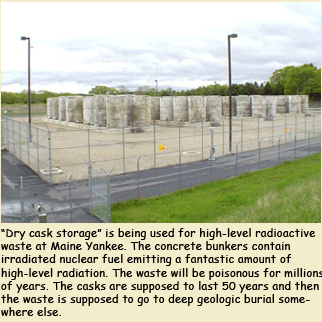 We are now 14 years into that lifespan,
with no plan in sight for what happens next. The residual radioactive
pollution in the soils and on the bottom of the bay will be with us
for a good deal longer than that. Now that nuclear power is included
as a component of our energy future as a “clean and green” source of
electricity, we feel compelled to share our story and what we have
learned.
We are now 14 years into that lifespan,
with no plan in sight for what happens next. The residual radioactive
pollution in the soils and on the bottom of the bay will be with us
for a good deal longer than that. Now that nuclear power is included
as a component of our energy future as a “clean and green” source of
electricity, we feel compelled to share our story and what we have
learned.
What we want to introduce into the conversation is a discussion of the routine radioactive releases into local soils, waters and air from the routine operation of a nuclear power plant, the ways in which these materials can bioconcentrate, the pathways by which they can enter the human body, and the probable detriments to the health of the surrounding populations from these routine releases.
According to the BEIR (Biological Effects of Ionizing Radiation) reports that have been released by the National Academy of Sciences, “there is no safe level or threshold of ionizing radiation.”
Even the lowest doses (meaning nearly zero) can cause cancer. Worse yet, mortality from radiation-induced cancer is 50% higher for women and 3-4 times higher for female babies and children.
A study done with Center For Disease Control (CDC) statistics by the Seacoast Anti-Pollution League showed that, within 30 miles of Seabrook from 1991 to 2002, the childhood cancer rate for children under 15 rose by about 19% after Seabrook began operating, while for the same period cancer rates significantly declined regionally and nationally.
A larger study done (also with CDC data) by the Radiation and Human Health Project on cancer incidence near US nuclear power plans showed the same results. (cf: Archives of the Journal of Environmental Health, 2003). Conversely, reactor closings across the US have been followed by sharp decreases in infant death and childhood cancer rates.
A study done by epidemiologist Dr. Theodore Hauschka, Dr. Peter C. Hauschka and Maria Holt and presented at the 7th Annual meeting of the American Association of Cancer Research in Atlanta on May 20th, 1987, showed significant increases in radiogenic leukemia in the seven counties surrounding Maine Yankee after the plant came on line in 1972.
A case-controlled study of childhood malignancies (acronym KiKK) done in Germany in the areas around all German nuclear plants showed with high statistical power a strongly increasing risk for childhood malignancies with residential proximity to any of the 16 German nuclear plants, The steepest rise in risk occurs within 5 kilometers, but significantly elevated risk extends to 50 kilometers. Tests for possible confounders found none, nor is chance a plausible explanation.
There is a huge and confusing body of scientific literature on this subject, and it seems to be possible to find one or more reputable studies to support every possible opinion.
Those responsible evaluating a policy of re-introducing nuclear power as a component of energy policy need to be aware of this controversy and respectful of these voices that warn of danger.
"To the village square
we must carry the facts
of atomic energy.
From there must come America's voice."
ALBERT EINSTEIN

~~~~~~
~~~~~~
NUCLEAR WASTE TRANSPORTATION:
IS GEORGIA AT RISK?
by Chris Joyner
Atlanta Journal-Constitution
10/29/15
RADIOACTIVE WASTE COULD BE TRANSPORTED THROUGH CHATTANOOGA, ANTI-NUCLEAR GROUP SAYS
Chattanooga Times Free Press
10/27/15
SOHN : THERE IS NO GOOD ANSWER FOR STORING NUCLEAR WASTE
by Pam Sohn
Chattanooga Times-Free Press
10/28/15
~~~~~~
YOU NEED TO KNOW THIS STUFF
H.O.S.S.
Hardened On-Site Storage
Nuclear Waste Management Plan
Institute for Energy and Environmental Research
Principles for Safeguarding Nuclear Waste at Reactors
signed by over 150 organizations
Spent Nuclear Fuel Pools in the U.S.
by Robert Alvarez
Spent Nuclear Fuel
Fact Sheet
~~~~~~
PANEL GETS CLEAR MESSAGE: RID MAINE OF NUCLEAR WASTE
by Tux Turkel
MAINE YANKEE WASTE IN FEDS' SIGHT
By Jim Kozubek
MAINE YANKEE'S RADIOACTIVE WASTE MUST GO
MONITORING MAINE YANKEE II:
Report of Citizens' Monitoring Group
1988-1998
by Maria Holt and Elisabeth King
ROCK SOLID?
A scientific review
of geological disposal
of
high-level
radioactive waste
by Helen Wallace for Greenpeace International
~~~~~~
KNOW ABOUT IT
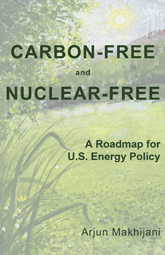
Breakthrough study by IEER proves we can get off coal, oil and nuclear by 2040
FREE DOWNLOAD
READ THE SUMMARY
VISIT THE WEBSITE
~~~~~~